MINNEAPOLIS (NewsNation) — Minnesota continues to pay millions of dollars to assisted living facilities owned by a man indicted for money laundering in the state’s massive Feeding Our Future fraud scandal, uncovering what may be a 15th program exploited for Medicaid fraud.
Gandi Mohamed, also known as Gandi Abdi Kediye, was indicted in February 2024 for allegedly laundering $1 million in the Feeding Our Future case.
His limited liability company owns multiple residential properties operating as assisted living facilities, which his wife runs. The facilities received over $2.3 million in state money last year while Mohamed awaits trial.
Mohamed has been paid $49 million by the state Department of Human Services since 2016, the Minnesota Reformer reported.
NewsNation visited three assisted living facilities owned by Mohamed’s LLC that operate out of single-family homes in the Minneapolis area. Staff at the facilities denied knowledge of the indictment.
Explosive growth in assisted living payments
Data shows suspicious patterns in Minnesota’s assisted living sector, with payment rates growing 10 to 15 times faster than other Medicaid programs, even as enrollment has only doubled.
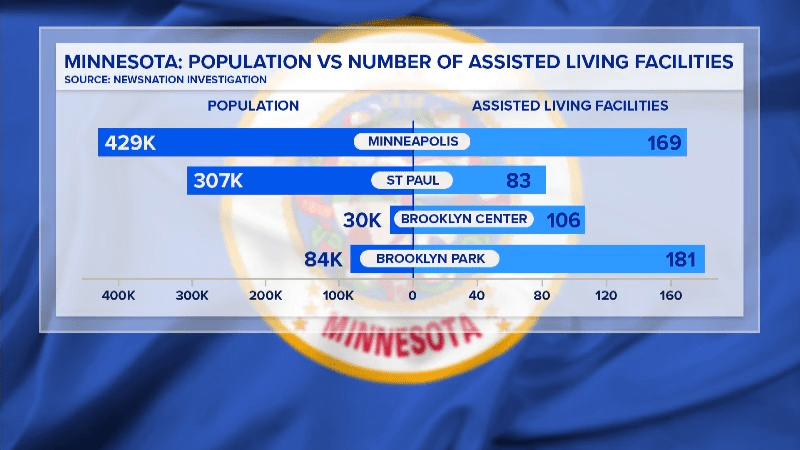
The concentration of facilities in smaller suburbs appears disproportionate to the population. Minneapolis, with a population of nearly 430,000, has 169 assisted living facilities. But Brooklyn Park, with 84,000 residents, has 181 facilities — more than Minneapolis, a city five times its size. Brooklyn Center, with just 30,000 residents, has 106 facilities, compared to 83 in St. Paul, which has a population of 307,000.
“It seems like the most basic due diligence would have been to run a check of all the people indicted in Feeding Our Future, and then make sure they’re not getting paid from other state programs,” said state Rep. Kristin Robbins, (R-Minn.), chair of the Minnesota House Oversight Committee. “And at least in this case, and I’ve heard, perhaps in others, they didn’t do that.”
Robbins noted that one of Mohamed’s properties was purchased with the same shell company he allegedly used to launder money in Feeding Our Future and that company has since been used to buy another assisted living facility.
“It’s unconscionable that they haven’t done the most basic due diligence to cross-check that Feeding Our Future defendants aren’t getting additional state money,” Robbins said.
She said a state statute permits authorities to stop payments when there are credible allegations of fraud.
State cites legal limitations
The Department of Human Services defended its continued payments, saying it faces statutory limitations on when it can cut off funding.
“DHS is statutorily limited on when it can act to cut off funding,” the agency said in a statement. “DHS cannot withhold payments for a business only based on an indicted individual being a landlord for a property. If the indicted person were an owner or had a role in the operation of a company delivering Medicaid services, DHS would have authority to withhold payment.”
The agency did not address questions about Mohamed’s wife operating the facilities or his LLC’s ownership of the properties.
Pattern of Medicaid fraud
Prosecutors have identified 14 different programs used to defraud Medicaid in Minnesota, with the assisted living sector potentially becoming the 15th. The Feeding Our Future case alone involved over $250 million in fraudulent billings and dozens of indictments.
The discovery follows mounting scrutiny of Minnesota’s oversight of public assistance programs after a viral video last week showed licensed day care centers that appeared empty despite receiving millions in taxpayer funds.
Federal agencies, including DHS, FBI and ICE, have launched investigations into suspected fraud at child care and health care facilities across the state.