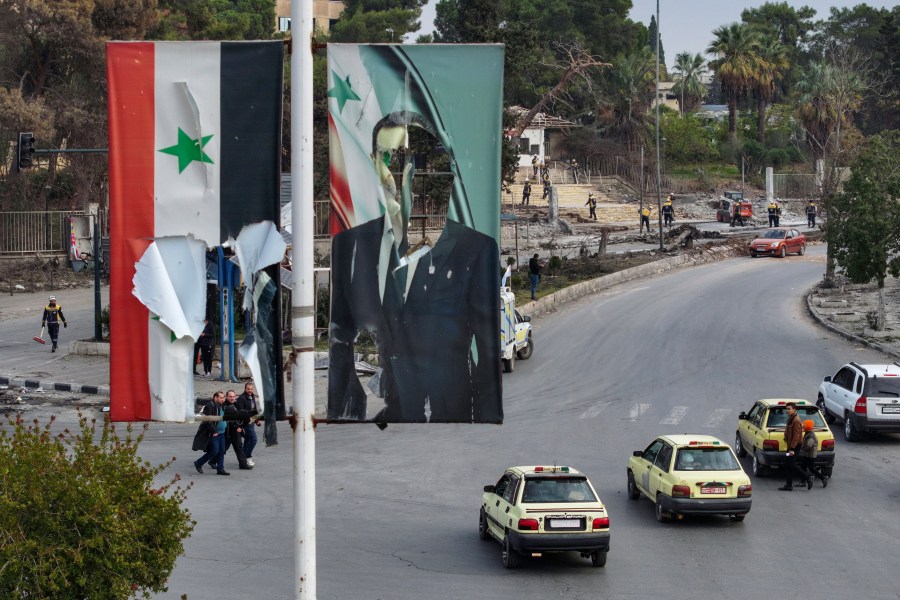
(NewsNation) — The reign of Syrian President Bashar al-Assad ended abruptly after he fled to Russia over the weekend as rebel troops overtook Damascus and seized control of the city.
The ousted president was given asylum in Russia while thousands of Syrian people poured into the streets and waved the revolutionary flag, celebrating al-Assad’s ousting, The Associated Press reported. The end of al-Assad’s presidency also ends more than five decades of iron-fisted rule by his family.
The end of the al-Assad regime drew a quick response from President Joe Biden and President-elect Donald Trump.
Biden said that al-Assad’s ouster is a “fundamental act of justice” but that it also represents “a moment of risk and uncertainty.”
How Bashar al-Assad came to power
Al-Assad took power in 2000 after he rose to power in an election in which he ran unopposed following the death of his father, Hafez al-Assad.
The elder al-Assad took power in 1970 after rising from poverty to lead the Baath party. Before taking over the Syrian presidency, Bashar al-Assad worked as an ophthalmologist after he studied medicine in London. In 2000, he married his wife, Asma, who worked as an investment banker at JP Morgan.
Bashar al-Assad was not originally poised to be his father’s successor. However, he moved into that role after his older brother, Bassel, died in a car accident in 1994. After his brother’s death, al-Assad studied military science and later became a colonel in the Syrian army, CNN reported.
Al-Assad was 34 years of age at the time of his father’s death, but it took only a matter of hours for the Syrian parliament to change the country’s constitution, which previously required a person to be 40 to serve as president, according to the report.
After al-Assad was elected, some observers in Europe and the United States believed change could be coming. CNN reported that al-Assad promoted himself as someone who may introduce a more progressive and moderate regime.
However, he maintained Syria’s ties with Hamas and Hezbollah militant groups, which led to an extension of the style of leadership that began under al-Assad’s father.
The younger al-Assad has been reelected seven times by sweeping majorities. His last reelection took place in 2021 in a result that officials from the United States, United Kingdom, France, Germany and Italy characterized as fraudulent.
Al-Assad’s forces during the civil war
Civil war broke out in Syria after military forces under al-Assad’s leadership became known for brutal tactics that were used to crack down on antidemocracy protests.
Rebel forces were made up of smaller organic militias and defectors from the Syrian military, CNN reported. Two years later, United Nations weapons inspectors found overwhelming evidence of the use of nerve gas in Syria.
An attack in August 2013 took place in the Damascus suburbs that may have killed 1,400 people, including hundreds of civilians, a report from the U.S. Department of State indicated. Since then, Syrian officials have denied that they were involved in war crimes and crimes against humanity.
Al-Assad warned Western countries against supporting rebel troops and said that if they became involved, the United States and other countries would be the target of Syrian militants. In 2015, Syria refused to join a coalition led by the U.S. to destroy ISIS.
Although the number of casualties tied to the civil war varies, multiple media reports estimate that the death total is more than 500,000. Of the casualties, at least 164,000 civilians have died since 2011. More than 343,000 combatants, including army soldiers and fighters from pro-Iranian groups, are counted among the dead.
Al-Assad and the Arab Spring
The Arab Spring was a wave of pro-democracy protests and uprisings that took place in the Middle East beginning in 2010.
The protests, which sought to challenge established authoritarian regimes, began with uprisings in Tunisia and Egypt before similar efforts began in surrounding Arab countries. The Syrian protests called for al-Assad to resign from power and spread throughout the country. The al-Assad regime responded with a crackdown against protesters. However, despite the opposition to his presidency, al-Assad remained in power as he was able to maintain the support of critical military groups.
The Guardian reported that security forces fired on demonstrators and relied on heavily armed pro-regime militias to operate as death squads. Al-Assad defended the response of his troops, saying that the bloodshed was in response to a “war on terror.” The report said that he once described the death of military members who were loyal to the regime as being necessary.
The Guardian also reported that military advisors from Russia began arriving to bolster the efforts to combat the Arab Spring and that al-Assad signed off daily on the continuing violence.
Al-Assad’s escape to Russia
Al-Assad’s whereabouts remain unknown after he was provided asylum by Russian officials.
The New York Times reported that Russian President Vladamir Putin was behind the decision to offer exile to al-Assad and his family but that there are no immediate plans for the two leaders to meet.
The report indicated that al-Assad was flown to Russia over the weekend after rebel troops overtook Damascus. The Associated Press reported that Syrian insurgents had guaranteed the security of Russian military bases and diplomatic posts in Syria.
The AP reported that Assad left Syria after negotiations with rebel groups and that he had given instructions for power to be transferred peacefully,
The report also indicated that Abu Mohammad al-Golani, the leader of Syria’s largest rebel faction, is slated to begin charting a new direction for Syria now that al-Assad’s reign of power has ended.
The Associated Press contributed reporting to this article.