MOSCOW (AP) —A Moscow court on Friday considered a request to put several allies of Russian opposition leader Alexei Navalny under house arrest as authorities work to stymie more protests over the jailing of the anti-corruption investigator.
Navalny’s supporters are calling for rallies on Sunday to demand his release. Tens of thousands of people rallied across Russia last weekend to protest his Jan. 17 arrest and 30-day detention.
The 44-year-old Navalny, the best-known critic of President Vladimir Putin’s government, was arrested upon returning from Germany, where he spent five months recovering from nerve-agent poisoning that he blames on the Kremlin. Russian authorities have rejected the accusations.
Navalny was jailed for 30 days after Russia’s prison service alleged he had violated the probation terms of his suspended sentence from a 2014 money-laundering conviction that he has rejected as politically motivated. On Thursday, a Moscow court rejected his appeal to be released, and another hearing next week could turn his 3 1/2-year suspended sentence into one he must serve in prison.
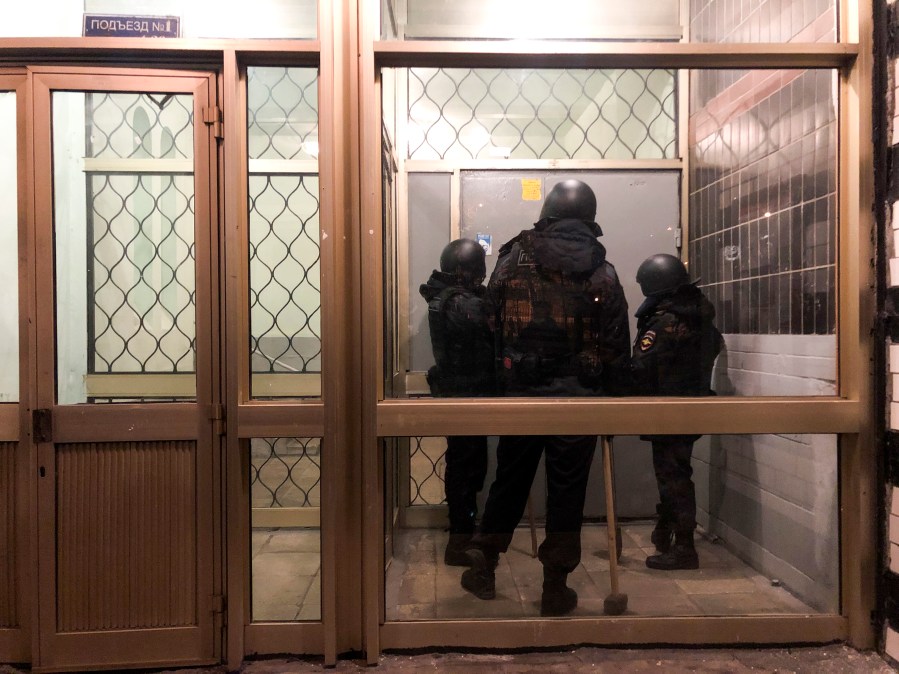
Police stand in front of a door of the apartment building where Oleg Navalny, brother of jailed opposition leader Alexei Navalny lives in Moscow, Russia, Wednesday, Jan. 27, 2021. Police are searching the Moscow apartment of jailed Russian opposition leader Alexei Navalny, another apartment where his wife is living and two offices of his anti-corruption organization. Navalny’s aides reported the Wednesday raids on social media. (AP Photo/Mstyslav Chernov) 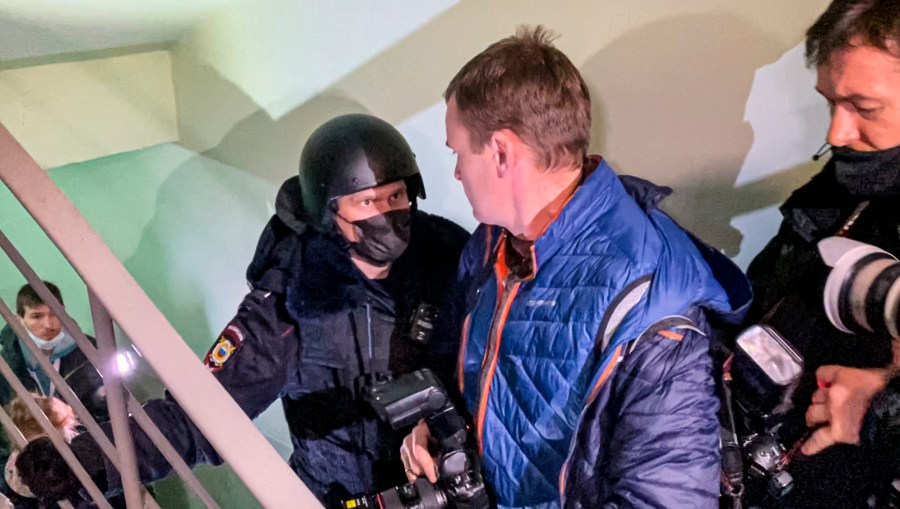
A police officer pushes photographers from a door of the apartment where Oleg Navalny, brother of jailed opposition leader Alexei Navalny lives in Moscow, Russia, Wednesday, Jan. 27, 2021. Police are searching the Moscow apartment of jailed Russian opposition leader Alexei Navalny, another apartment where his wife is living and two offices of his anti-corruption organization. Navalny’s aides reported the Wednesday raids on social media. (AP Photo/Mstyslav Chernov) 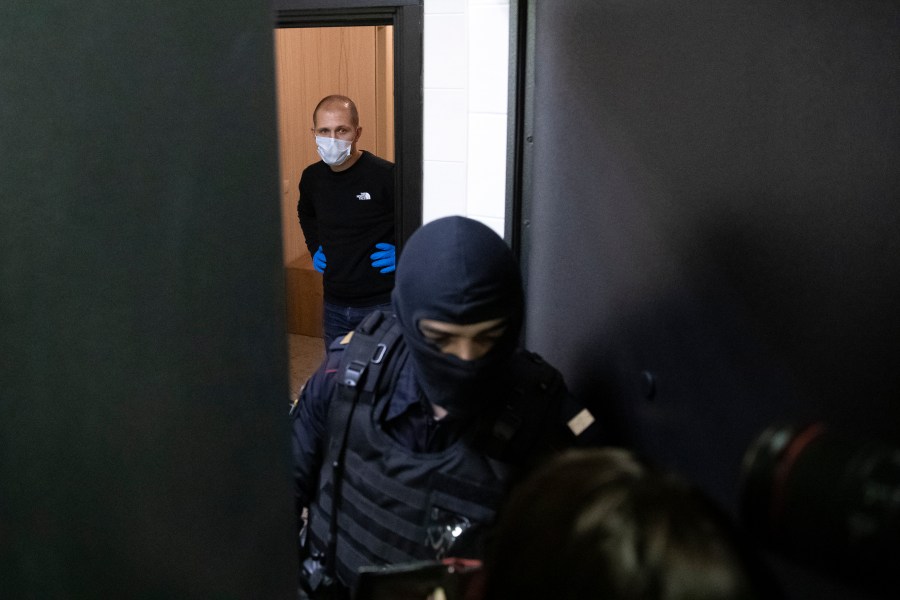
A police officer and an investigator stands behind the door of the apartment of jailed opposition leader Alexei Navalny in Moscow, Russia, Wednesday, Jan. 27, 2021. Police are searching the Moscow apartment of jailed Russian opposition leader Alexei Navalny, another apartment where his wife is living and two offices of his anti-corruption organization. Navalny’s aides reported the Wednesday raids on social media. (AP Photo/Pavel Golovkin) 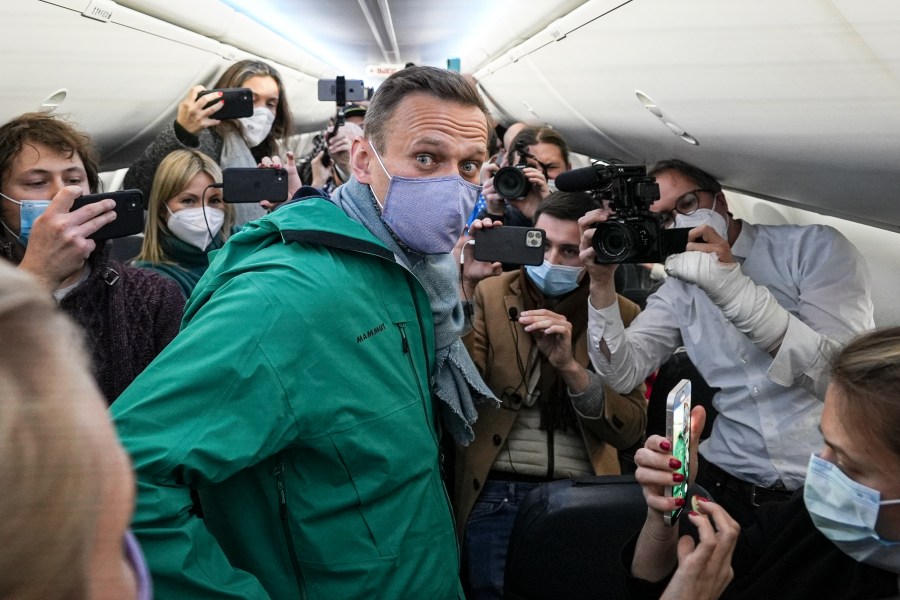
FILE – In this Jan. 17, 2021, file photo, Alexei Navalny is surrounded by journalists in a plane before a flight to Moscow in the Berlin Brandenburg Airport. Rattled by nationwide protests over Navalny, Russian authorities are moving rapidly to block any new ones – from putting legal pressure on his allies to launching a campaign to discredit the demonstrations. (AP Photo/Mstyslav Chernov, File) 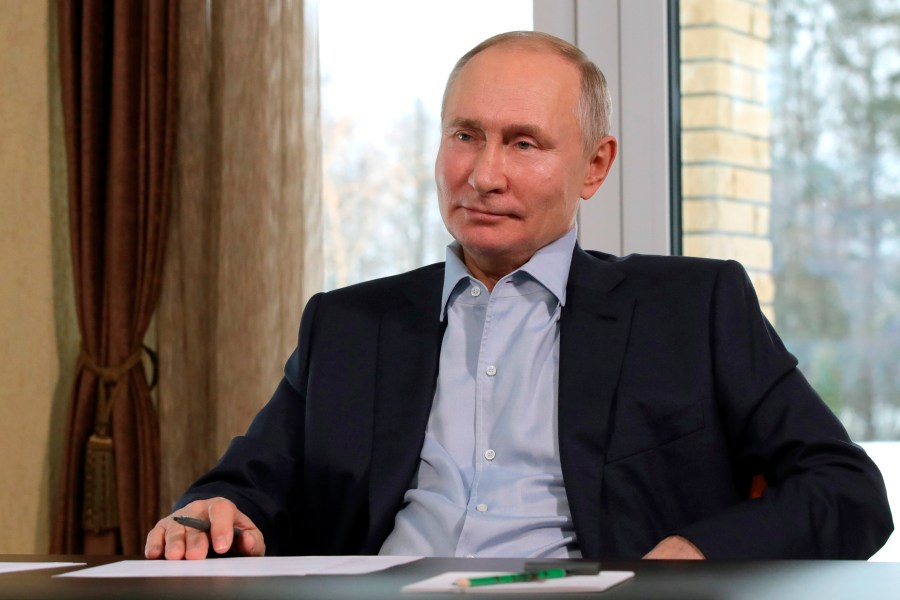
FILE – In this Jan. 25, 2021, file photo, Russian President Vladimir Putin attends a meeting with university students marking Russian Students’ Day on Monday via video conference in Zavidovo, north of Moscow, Russia. Rattled by nationwide protests over jailed opposition leader Alexei Navalny, authorities are moving to block any new ones – from piling legal pressure on his allies to launching a campaign to discredit the demonstrations. (Mikhail Klimentyev/Sputnik, Kremlin Pool Photo via AP, File) 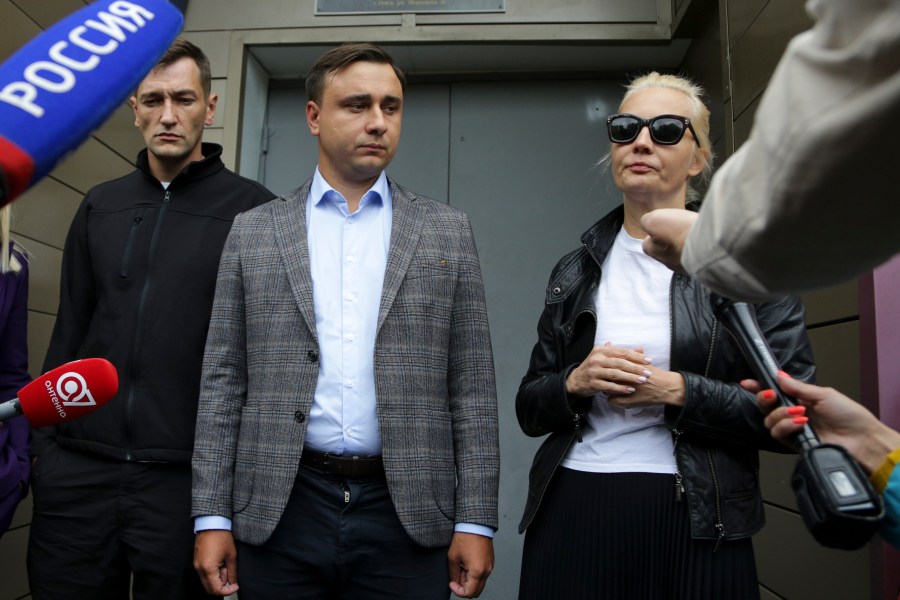
FILE – In this Aug. 21, 2020, file photo, Alexei Navalny’s brother Oleg Navalny, left, Navalny’s colleague Ivan Zhdanov, center, and Alexei Navalny’s wife Yulia speak to the media at the Omsk Ambulance Hospital No. 1, where the opposition leader was hospitalized in Omsk, Russia. Rattled by the nationwide demonstrations in support of the Kremlin foe, authorities are moving rapidly to block any new ones – from piling legal pressure on his allies and aides to launching a campaign to discredit the demonstrations. On Wednesday, Jan. 17, 2021, Moscow police raided apartments and offices belonging to Navalny associates and opposition figures, including his own apartment and his brother’s. (AP Photo/Evgeniy Sofiychuk, File) 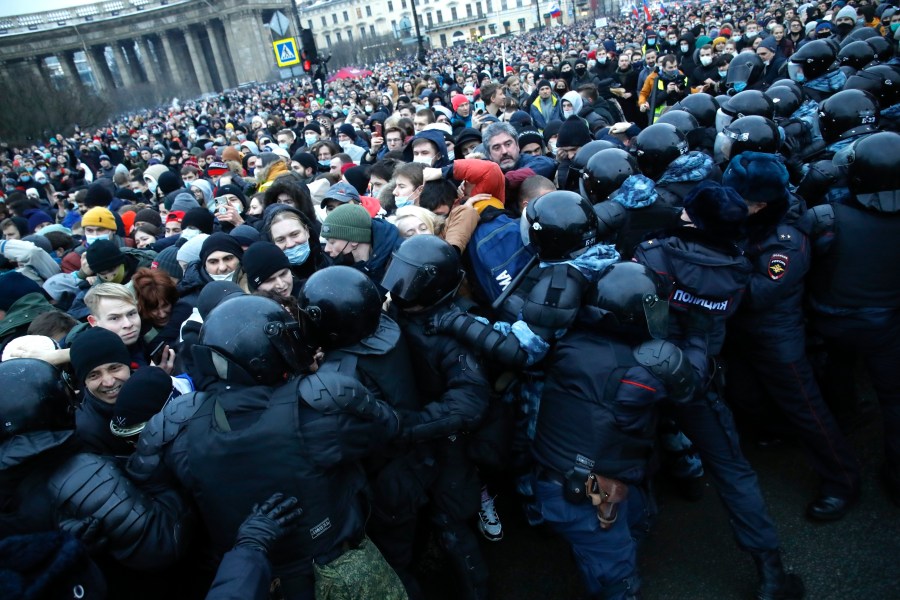
FILE – In this Jan. 23, 2021, file photo, people in St. Petersburg, Russia, clash with police while protesting the jailing of opposition leader Alexei Navalny. Rattled by the nationwide demonstrations in support of the Kremlin foe, authorities are moving rapidly to block any new ones – from piling legal pressure on his allies to launching a campaign to discredit the demonstrations. (AP Photo/Dmitri Lovetsky, File) 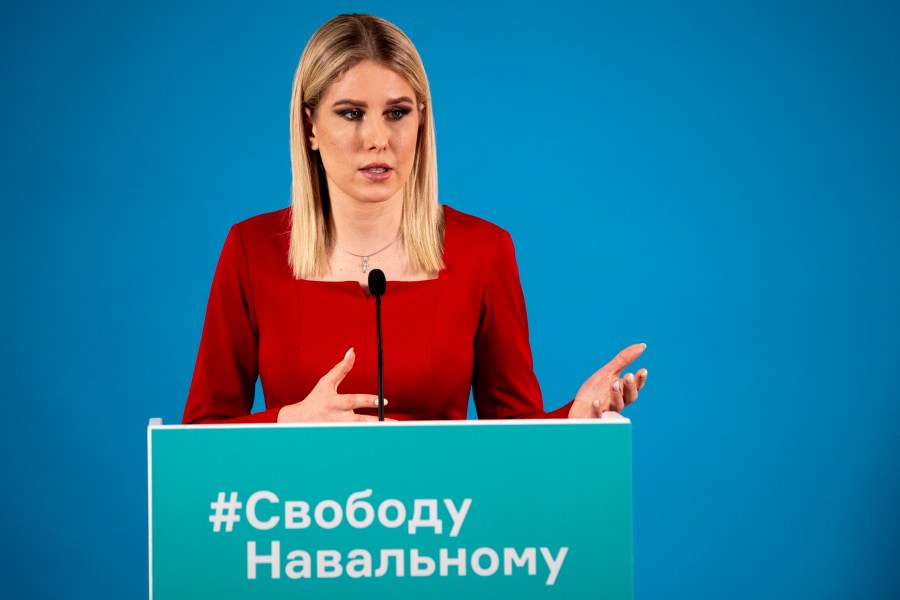
FILE – In this file photo taken on Tuesday, Jan. 26, 2021, Lyubov Sobol, an ally of jailed Russian opposition leader Alexei Navalny, speaks during a videoconference in Moscow, Russia. The words on her lectern read “Free Navalny.” Rattled by the nationwide demonstrations supporting him, Russian authorities are moving rapidly to block any new ones – from piling legal pressure on his allies to discrediting the rallies. On Wednesday, Moscow police raided apartments and offices belonging to Navalny associates and opposition figures, including his own apartment and Sobol’s. (AP Photo/Pavel Golovkin, File) 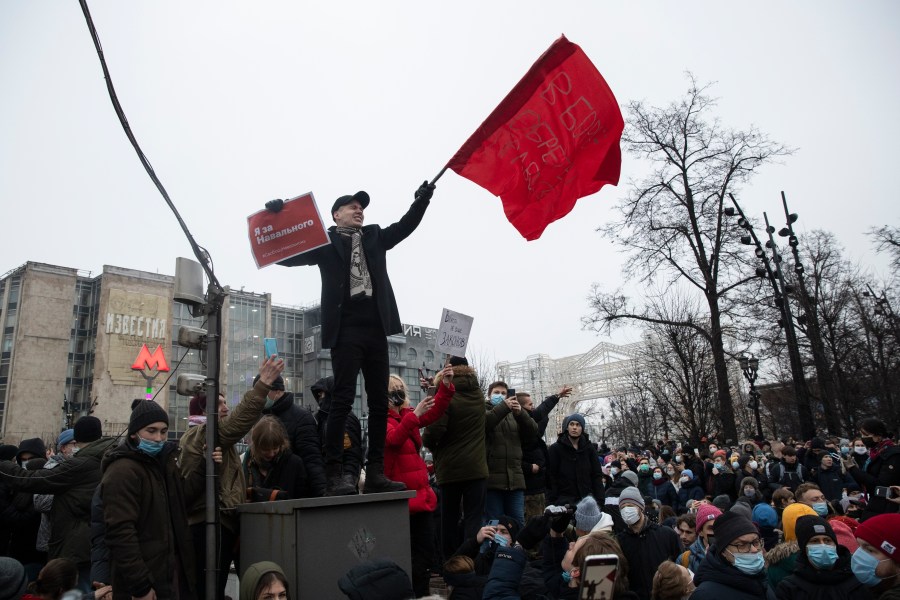
FILE – In this Jan. 23, 2021, file photo, a demonstrator waves a red flag and holds a banner that reads: “I’m for Navalny,” at a protest supporting jailed opposition leader Alexei Navalny in Moscow, Russia. Rattled by the nationwide demonstrations supporting him, Russian authorities are moving rapidly to block any new ones – from piling legal pressure on his allies to launching a campaign to discredit the rallies. (AP Photo/Pavel Golovkin, File) 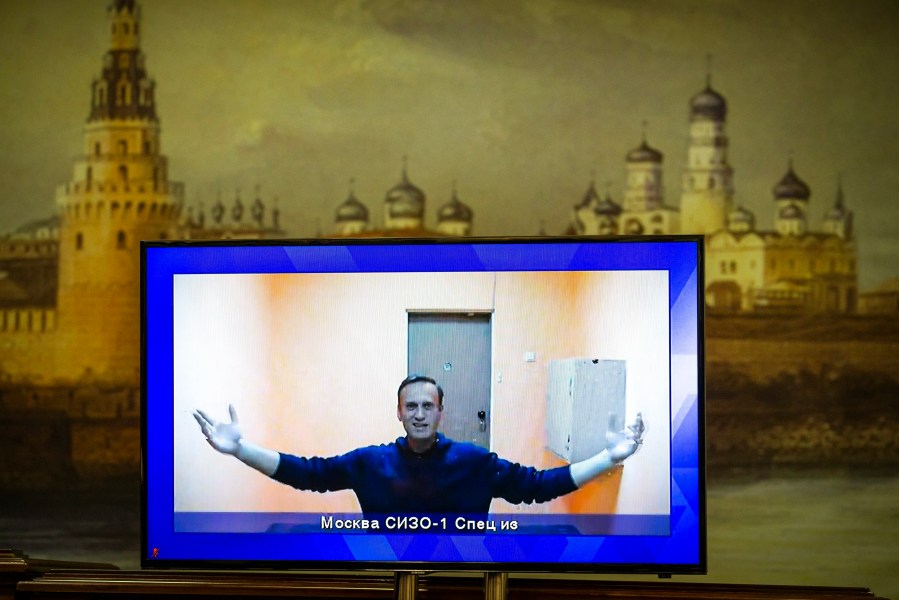
FILE – In this Jan. 28, 2021, file photo, Russian opposition leader Alexei Navalny appears on a TV screen during a court hearing appealing his jailing, with an image of the Kremlin in the background in Moscow, Russia. Navalny was jailed when he arrived in Moscow on Jan. 17, after authorities accused him of violating the terms of his parole on a 2014 fraud conviction. (AP Photo/Alexander Zemlianichenko, File)
As part of government efforts to stem the protests, police detained Navalny’s brother, Oleg; his top ally, Lyubov Sobol; Oleg Stepanov, the head of Navalny’s Moscow office; Dr. Anastasia Vasilyeva from the Navalny-backed Alliance of Doctors; and Maria Alekhina from the Pussy Riot punk collective. They were detained for 48 hours as part of a criminal probe into alleged violations of coronavirus regulations during last weekend’s protests.
Sobol’s lawyer, Vladimir Voronin, said on Twitter that investigators asked Moscow’s Tverskoy District Court to put Sobol and the four others under house arrest.
In a strong challenge to the Kremlin, demonstrations calling for Navalny’s release took place in more than 100 Russian cities on Jan. 23. Nearly 4,000 people were reportedly detained at those protests, and some were given fines and jail terms.
In Moscow, over 1,600 people have been charged with violations, and 154 received jail terms ranging from seven to 15 days for their involvement in the protests, the Moscow City Court said Friday.
Russia’s Investigative Committee said it put Navalny’s top strategist, Leonid Volkov, on the wanted list on charges of encouraging minors to participate in unauthorized rallies. Volkov, who has lived abroad since 2019, has rejected the charges.
Navalny’s arrest and the harsh police actions at the protests have brought wide criticism from the West and calls for his release.
Appearing in court via video link from the Matrosskaya Tishina jail, Navalny on Thursday denounced the criminal proceedings against him as part of a government campaign to intimidate the opposition.
“You won’t succeed in scaring tens of millions of people who have been robbed by that government,” he said. “Yes, you have the power now to put me in handcuffs, but it’s not going to last forever.”
Navalny fell into a coma on Aug. 20 while on a domestic flight from Siberia to Moscow. He was transferred to a Berlin hospital two days later. Labs in Germany, France and Sweden, and tests by the Organization for the Prohibition of Chemical Weapons, established that he was exposed to the Soviet-era Novichok nerve agent.
Russian authorities have refused to open a full-fledged criminal inquiry, citing a lack of evidence that he was poisoned.