(NewsNation) — NASA’s big reveal Wednesday of 3I/ATLAS images and the agency’s assertions it’s just a comet haven’t swayed Avi Loeb, the Harvard astrophysicist who has theorized the interstellar object could be an alien vessel.
“Let’s wait and see,” Loeb told “Elizabeth Vargas Reports” on Wednesday. “Bureaucrats or unimaginative scientists want us to believe in the expected, but the rest of us know the best is yet to come.”
NASA officials released several images Wednesday and conceded that 3I/ATLAS, which comes from outside our solar system, is a most unusual specimen as comets go. Loeb counters that the new data doesn’t really offer anything new, nor does it explain the anomalies he’s been discussing for months. These include the unusually large size of 3I/ATLAS, its chemical signatures and the mysterious jets coming from the object’s surface.
“What they uncovered was the ‘skin’ of the object … some ices and perhaps some dust that evaporates when the sun illuminates that surface,” said Loeb, who had pressed NASA to release its latest images. “Even if you consider spacecraft that travels through the core of the interstellar medium, it would accumulate over time — ices and dust on it.”

The interstellar comet 3I/ATLAS, circled in the center, as seen by the L’LORRI panchromatic, or black-and-white, imager on NASA’s Lucy spacecraft. This image was made by stacking a series of images taken on Sept. 16, 2025, as the comet was zooming toward Mars. Lucy was 240 million miles away from 3I/ATLAS at the time making its way to explore eight asteroids that share an orbit with Jupiter. The L’LORRI imager captured the comet’s coma, the fuzzy halo of gas and dust surrounding 3I/ATLAS above, and its tail, a smudge of gas flowing to the right of the comet. This image spans about 11 arcminutes of sky, or roughly one-third the width of the full Moon. Solar system north is up. Image Credit: NASA/Goddard/SwRI/JHU-APL 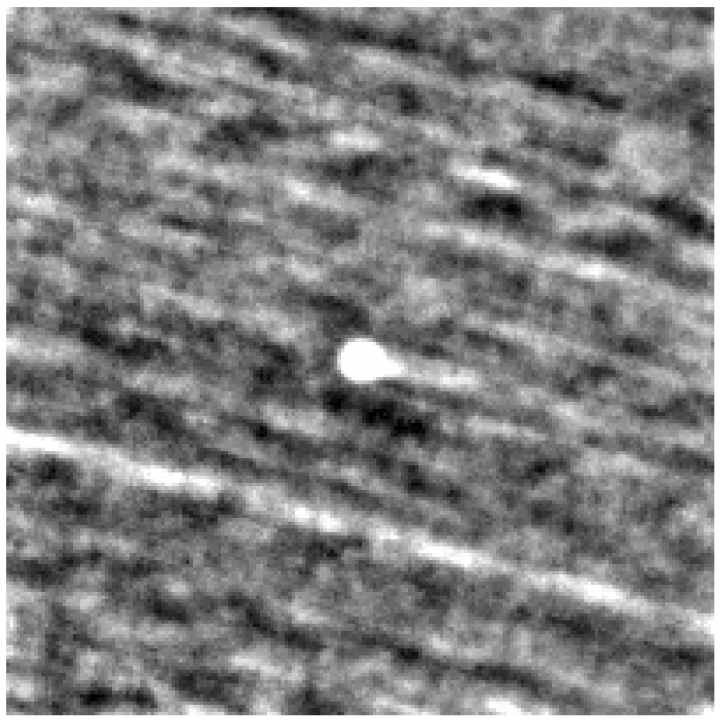
Comet 3I/ATLAS appears as a bright object near the center of this image, made from combining observations from NASA’s PUNCH mission taken from Sept. 20 to Oct. 3, 2025, when the comet was about 231 million to 235 million miles from Earth. Its tail appears as a short elongation to the right. Stars appear as streaks in the background. Image Credit: NASA/Southwest Research Institute 
An ultraviolet image composite of the hydrogen atoms surrounding comet 3I/ATLAS, the third interstellar object ever detected by astronomers, as it passes through our solar system. This image was taken on Sept 28, 2025- just days before the comet’s closest approach to Mars – by an instrument on NASA’s MAVEN spacecraft, which has been studying Mars from orbit since 2014. The instrument, the Imaging Ultraviolet Spectrograph, takes pictures in the ultraviolet part of the spectrum to reveal the chemical composition of objects. The image shows hydrogen emitted from different sources: the comet (dim spot on the far left), hydrogen from Mars (bright emission on the right), and hydrogen flowing through our solar system between the planets (dim emission in the middle). MAVEN’s spectrograph distinguished the comet’s hydrogen from the interplanetary and Martian hydrogen using a special mode to separate each source by its speed. Hydrogen emission from the comet is confined to the location of the comet on the sky, which is why it is small and round instead of extended. Image Credit: NASA/Goddard/LASP/CU Boulder 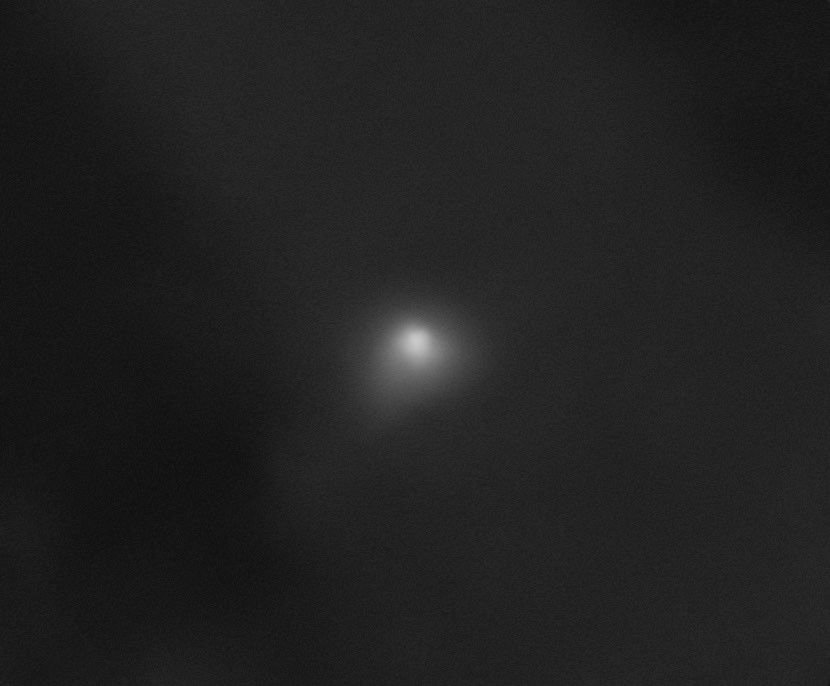
The High Resolution Imaging Science Experiment (HiRISE) camera aboard NASA’s Mars Reconnaissance Orbiter captured this image of interstellar comet 3I/ATLAS on Oct. 2, 2025. At the time it was imaged, the comet was about 0.2 astronomical units (19 million miles, or 30 million kilometers) from the spacecraft. Image Credit: NASA/JPL-Caltech/University of Arizona 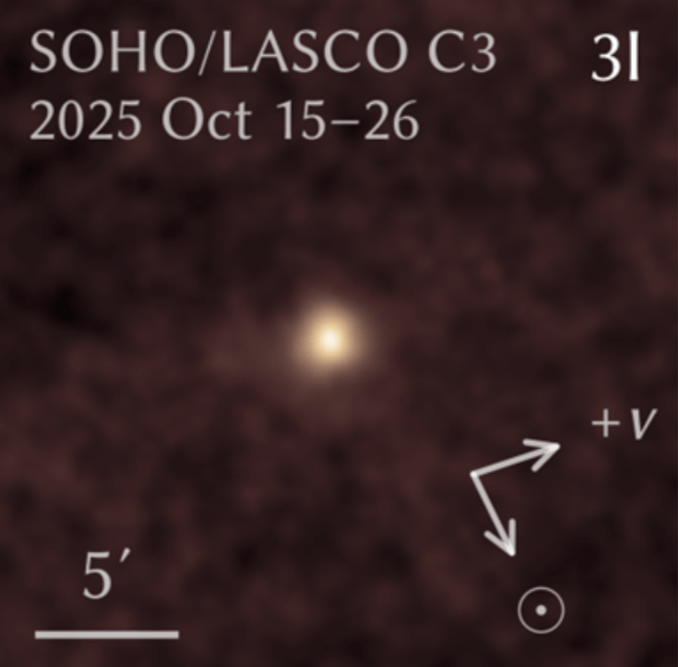
A faint image of comet 3I/ATLAS as observed by ESA/NASA’s SOHO mission between Oct. 15-16, 2025. The comet appears as a slight brightening in the center of the image. Image Credit: Lowell Observatory/Qicheng Zhang 
This image shows the halo of gas and dust, or coma, surrounding comet 3I/ATLAS, the third interstellar object ever detected by astronomers as it passes through our solar system. The image was taken on Oct. 9, 2025, by an instrument onboard NASA’s MAVEN spacecraft, which has been studying Mars from its orbit since 2014. The instrument, the Imaging Ultraviolet Spectrograph, takes pictures in the ultraviolet part of the spectrum to reveal the chemical composition of objects. The center of the image has the brightest pixel, indicating where the comet is. The next brightest shades in the image indicate areas where the instrument detected atoms of hydrogen coming from the comet. This hydrogen is released when sunlight heats the comet, causing its water ice to turn directly into vapor. Once released into space, the water molecules break apart into oxygen and hydrogen atoms. Image Credit: NASA/Goddard/LASP/CU Boulder
So, when will Earthlings definitively know whether 3I/ATLAS is of intelligent design?
Loeb says we should be able to figure that out by the time the object reaches its closest point — 170 million miles away from our planet — Dec. 19.
“I would say by Dec. 19 we would have enough data. There would be a flood of data that would tell us what this object is,” he said.
Michio Kaku speculates on age of 3I/ATLAS
One of Loeb’s colleagues, author and theoretical physicist Michio Kaku, has said the unique characteristics of 3I/ATLAS, compared to other comets, is likely attributable to its vast age of 7 billion years.
“Over 7 billion years, it’s had plenty of time to accumulate different gases, different elements, different kinds of environments that it goes into,” he told NewsNation recently. “I think that explains a lot of the mystery behind the comet.”