(NewsNation) — For days on end, fires in the Los Angeles area have filled Southern California’s air with smoke and pollutants.
It’s especially concerning when the places burning are urban centers, as it’s not just shrubs and trees burning but houses and buildings that could contain dangerous chemicals, Dr. Lipi Roy told NewsNation.
“Houses have paint, rubber, metal, steel. When those burn, they release really toxic fumes and ash,” Roy explained.
And those fumes, ash and smoke particles can spread for hundreds or even thousands of miles beyond the fire’s genesis.
What is in wildfire smoke?
PM2.5, or particulate matter emitted from smoke, are tiny particles made up of chemicals, dust, soot and metals.
When wildfires break out, the small particles are released into the air and then inhaled, causing irritation in the eyes, nose, throat and lungs, according to public health officials.
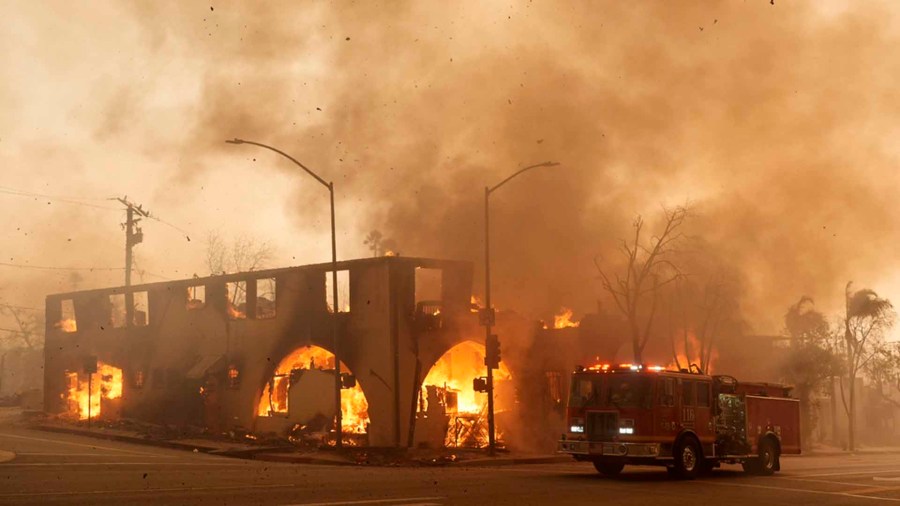
Smoke and debris fill the air as a structure on Lake Avenue burns Jan. 8 in the downtown Altadena section of Pasadena, Calif. (AP Photo/Chris Pizzello) 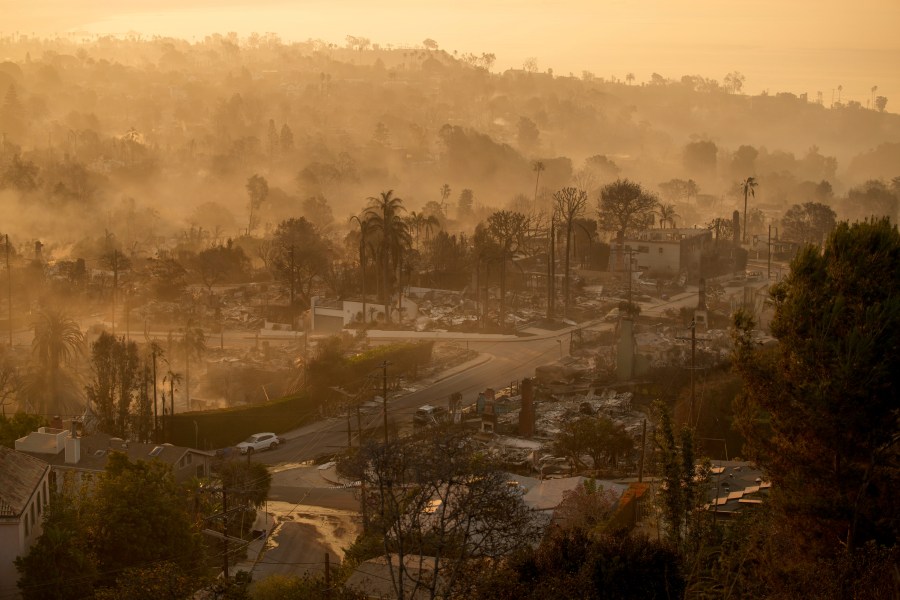
The devastation of the Palisades Fire is seen in the early morning in the Pacific Palisades neighborhood of Los Angeles, Friday, Jan. 10, 2025. (AP Photo/John Locher) 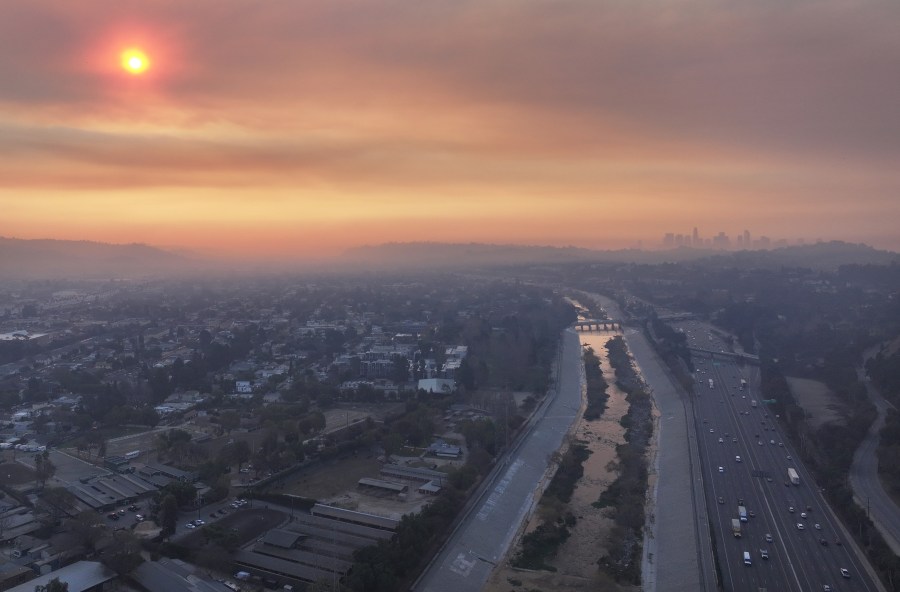
Wildfire smoke hangs over downtown Los Angeles amid poor air quality in the region on Jan. 09. Multiple wildfires fueled by intense Santa Ana winds are burning across Los Angeles County. At least five people have been killed, and over 25,000 acres have burned. Over 2,000 structures have also burned and almost 180,000 people are under orders to evacuate. 
A brush fire burns near homes in Pacific Palisafes, California on January 7, 2025. A fast-moving brushfire in a Los Angeles suburb burned buildings and sparked evacuations Tuesday as “life threatening” winds whipped the region. More than 200 acres (80 hectares) was burning in Pacific Palisades, a upscale spot with multi-million dollar homes in the Santa Monica Mountains, shuttering a key highway and blanketing the area with thick smoke. (Photo by David Swanson / AFP) (Photo by DAVID SWANSON/AFP via Getty Images)
Smoke exposure health effects
Short-term exposure to PM2.5 has been linked to premature death, hospital admissions, bronchitis, asthma attacks and other respiratory and cardiac problems, the California Air Resources Board said.
Roy warned that long-term exposure can lead to dementia, Alzheimer’s, Parkinson’s, diabetes and lung cancer, among others.
Particle pollution also triggers asthma attacks, heart attacks and strokes and can cause death, according to the American Lung Association.
People at higher risk, children, the elderly, those with respiratory or heart conditions and people with compromised immune systems may experience more severe effects such as difficulty breathing, wheezing, coughing, fatigue, and/or chest pain.
The World Health Organization associates 7 million premature deaths annually to indoor and outdoor air pollution.
How to protect yourself from wildfire smoke
The best way to protect yourself from wildfire smoke is to get far away from the source. If movement isn’t an option, it’s best to stay indoors and limit any outdoor activity when conditions are smoky.
Inside, make sure your doors and windows are tightly closed and sealed.
An air filter or HVAC system with air filters can help maintain healthy indoor air quality, and portable air purifiers can help as well, according to the CDC.
It’s important to run your fan the entire time, otherwise the air will only be filtered when cooling. If your system operates using a fresh air intake, close it.
If you have to stay outside, wearing a respirator mask and taking frequent breaks is crucial for your well-being.
Which masks best protect from wildfire smoke?
Health experts say N95 respirator masks offer the best protection against harmful wildfire smoke, provided they are worn correctly and fit properly.
You should look for masks with two straps that are certified by the National Institute of Occupational Safety and Health.
N95 respirator masks are readily available at hardware stores and pharmacies. Other options, like single-strap paper dust and surgical masks, don’t adequately protect from wildfire smoke.
If your mask is damaged, the inside becomes dirty or breathing gets difficult, experts say to ditch that mask and get a new one.
Southern California’s air quality
According to the South Coast Air Quality Management District, the potential direct smoke impact from the Palisades wildfire burning has caused “unhealthy” air quality in Los Angeles County.
The grading has fluctuated between “hazardous,” which is the most extreme rating, to “unhealthy,” which is one notch below.
That’s expected to change as fires rage on. Click here to check your air quality.
NewsNation’s Safia Samee Ali, Ashley Soriano and Damita Menezes contributed to this report.