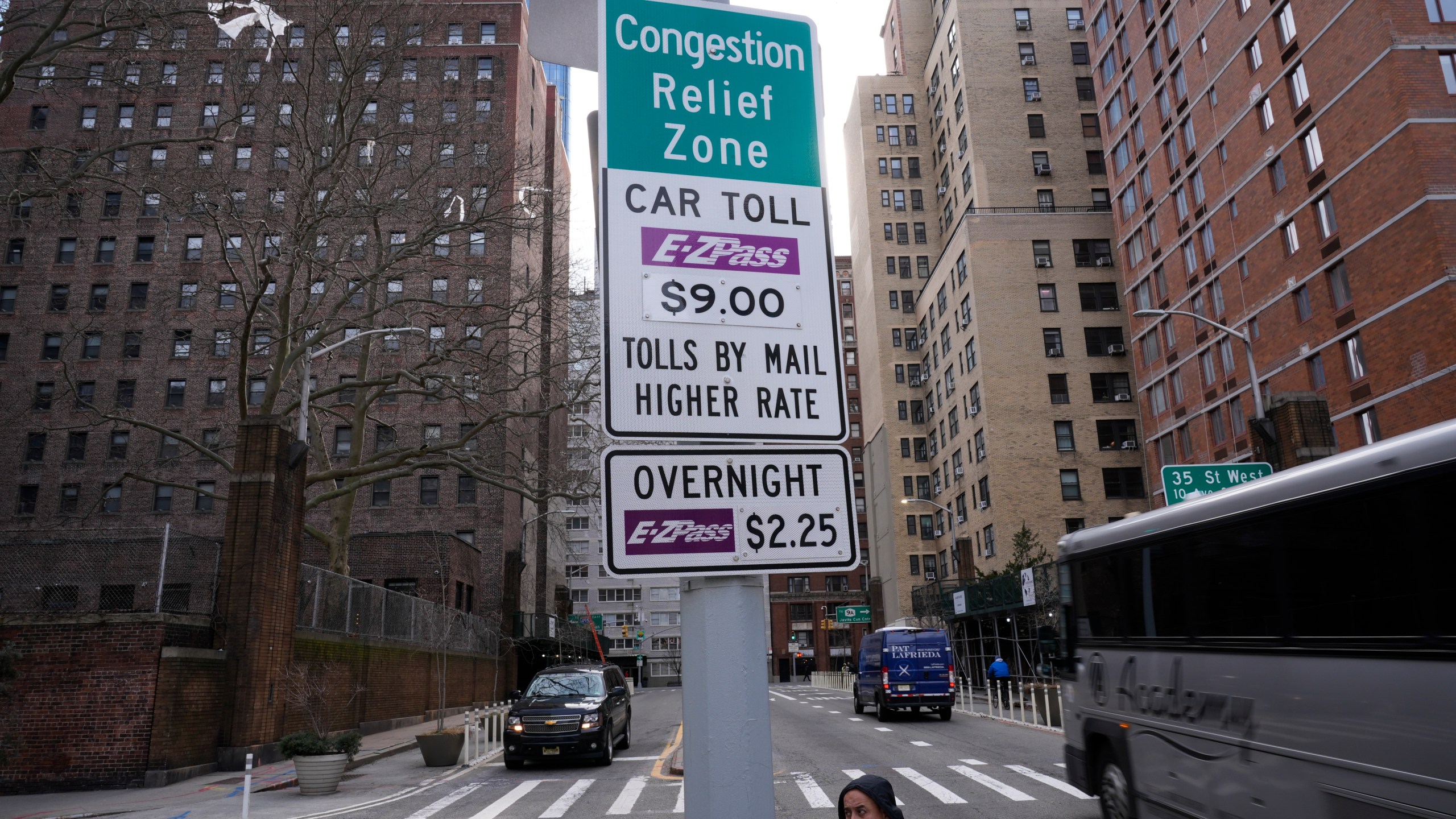
ALBANY, N.Y. (NEXSTAR) — One year since New York City began charging drivers a $9 toll, state officials say the controversial program cut traffic by 11% and raised some $550 million. Governor Kathy Hochul announced the results Monday, calling the drop in gridlock and pollution a transformational success despite ongoing legal fights with the feds.
“We changed how people in this great city and the region live, how they breathe, how they act, and now the results are in,” Hochul said.
The revenue lets the Metropolitan Transportation Authority proceed with $15 billion in construction projects that were at risk under a previous budget gap. Their plans include extending the Second Avenue Subway, buying new railcars, and upgrading signals on the A, C, and F lines to reduce delays for commuters in Brooklyn and Queens.
The congestion pricing program charges vehicles entering Manhattan south of 60th Street, an area called “the congestion zone.”
The toll faced opposition from suburban drivers, Republicans, New Jersians, and the federal government, who all argued that it would hurt the economy by making it too hard to freely enter the city. These critics said the fees would drive business to the suburbs and make the area a ghost town.
But the MTA released data showing that businesses in the congestion zone are thriving. A December 2025 report from the NYC Economic Development Corporation showed that Broadway ticket sales rose by 23%, and the city saw its best year for office leasing since 2002. Empty storefronts in the area dropped, too, and sales tax in New York City rose by more than 6% through November. That local spending grew three times faster than in neighboring Westchester County and six times faster than in Nassau County.
Their data also showed that travel speeds have increased—traffic is moving faster. Bus speeds in the congestion zone rose for the first time in years, according to the Central Business District Tolling Program First Annual Evaluation Report, released in December.
And those who drive still drive into the congestion zone arrive at their destination sooner. Speeds at the Holland Tunnel up by 51% during the morning rush. Queensboro Bridge speeds increased by 29%, and Williamsburg Bridge traffic also moved 28% faster, CBDTP found.
According to Hochul, daily commuters are saving up to 117 hours annually, representing about five days in a year. And research affiliated with Stanford University estimated that those shorter trips represent some $14.3 million worth of time that commuters save every week. Their data showed that traffic patterns shifted across the entire region, so even drivers who don’t pay the toll travel faster.
On the Cross Bronx Expressway, they said total traffic volume dropped by 7.4%, while truck traffic on the Brooklyn-Queens Expressway went at least 10% down. On the Major Deegan Expressway in Mott Haven—Interstate 87, which becomes the Thruway outside of NYC—truck traffic dropped by just over 9%. Still, other regional traffic volume—particularly on the Staten Island Expressway—apparently grew, but by under 1%, according to CBDTP.
All told, some 27 million fewer vehicles entered the congestion zone in 2025 than in 2024, per the MTA. And CBDTP’s data showed that the benefits extend beyond the Manhattan toll zone to communities that historically have to deal with most of the negative impacts of traffic.
The drop in volume coincided with the safest year on record for New York City street traffic. Inside the toll zone, serious injuries from crashes dropped by nearly 9%, per CBDTP, creating safer streets for some 600,000 cyclists and pedestrians every day. The state also cited CBDTP’s findings that traffic crashes in the zone fell by 7%.
And the neighborhood is also quieter, with traffic noise complaints in the zone falling by 23%. Crime within the transit system also appears to have dropped 5.5% compared to the previous year.
And, again according to the MTA, total ridership also increased by 7% to approach 1.9 billion trips, marking the busiest year since 2019. MTA also said the subways and trains throughout the city, Long Island, and the Hudson Valley are more punctual than they’ve been in almost a decade.
The Long Island Rail Road and Metro-North had their best on-time performances in years, with “Super-Express” service cutting travel times between Poughkeepsie and Grand Central. Even so, compared to ridership before the pandemic, that Metro North line is still only at 88%.
The air inside the toll zone may also be cleaner than it was a year ago. Hochul’s office cited a study indicating that dangerous air pollution particles dropped by 22% in the area. But a study from the National Bureau of Economic Research disagreed, stating that the program had “little-to-no effect on air quality” or “ambient concentrations of fine particulates.”
And the Regional Plan Association identified a negative side effect in the neighborhoods just outside the toll zone: illegal parking complaints jumped by 17% even as they fell inside of Manhattan.
Netting over half a billion dollars in the first year, congestion pricing also supports accessibility projects for New Yorkers with disabilities. Christopher Schuyler, a managing attorney with New York Lawyers for the Public Interest, said the funds go to projects like new elevators and faster trips for Access-A-Ride users.
The Tri-State Transportation Campaign also confirmed that toll revenues fund a new asthma case management program in the Bronx. This project targets residents in neighborhoods like Mott Haven, where heavy truck traffic historically caused high rates of respiratory illnesses.
The program still faces challenges from Washington. President Donald Trump and U.S. Department of Transportation Secretary Sean Duffy have tried to stop the program by revoking its pilot status and withholding federal transit grants, arguing that the model punishes car drivers. During a congressional hearing in July, Duffy argued that rising subway violence made public transit a dangerous alternative.
Hochul said the state will continue to defend the program, noting that judges have so far ruled in its favor.