(NewsNation) — The Department of Defense announced Monday the United States successfully completed two test flights of a reusable hypersonic aircraft, marking a significant step in the development of weapons capable of flying more than five times the speed of sound.
The advancement helps close the gap in hypersonic technology between the U.S. and rival powers like China and Russia, both of which already have hypersonic weapons at their disposal. Russia has used hypersonic missiles in its war against Ukraine.
The aircraft can attack from great distances and maneuver in ways that aim to trick adversaries and dodge traditional defenses. They are capable of carrying both conventional explosives and nuclear warheads.
Ballistic missiles can also travel at these hypersonic speeds; however, they have to follow a flight path. This makes them much easier to intercept before they reach their target. The U.S. also has cruise missiles, which can move around but travel much more slowly.
Pentagon hired tech startups to help with hypersonic aircraft
Under pressure from Congress to increase progress on hypersonic technology, the Pentagon, whose funding for its development has lagged over the years, enlisted two tech startups — Stratolaunch and Ursa Major.
The recent test flights involved an autonomous drone, the Talon-A, which was carried up from the Mojave Desert by a larger Roc carrier aircraft over the Pacific Ocean. The flights, conducted in December and March, reached speeds of Mach 5, the hypersonic threshold, according to the Pentagon.
According to the Wall Street Journal, hypersonic missiles are crucial, since they can travel anywhere in the world in less than an hour.
The Talon-A’s reusability is critical, allowing faster turnaround between missions and reducing costs.
What was the X-15 program?
The test marks the country’s first return to reusable hypersonic flight trials since the manned X-15 program ended nearly 60 years ago, highlighting the urgency of advancing America’s hypersonic capabilities.
The North American X-15 hypersonic aircraft was operated by NASA and the U.S. Air Force. In 1967, it reached its highest speed of 4,520 mph. The program allowed 12 pilots to fly on nearly 200 flights. Some pilots were even classified as astronauts by exceeding 50 miles in altitude.
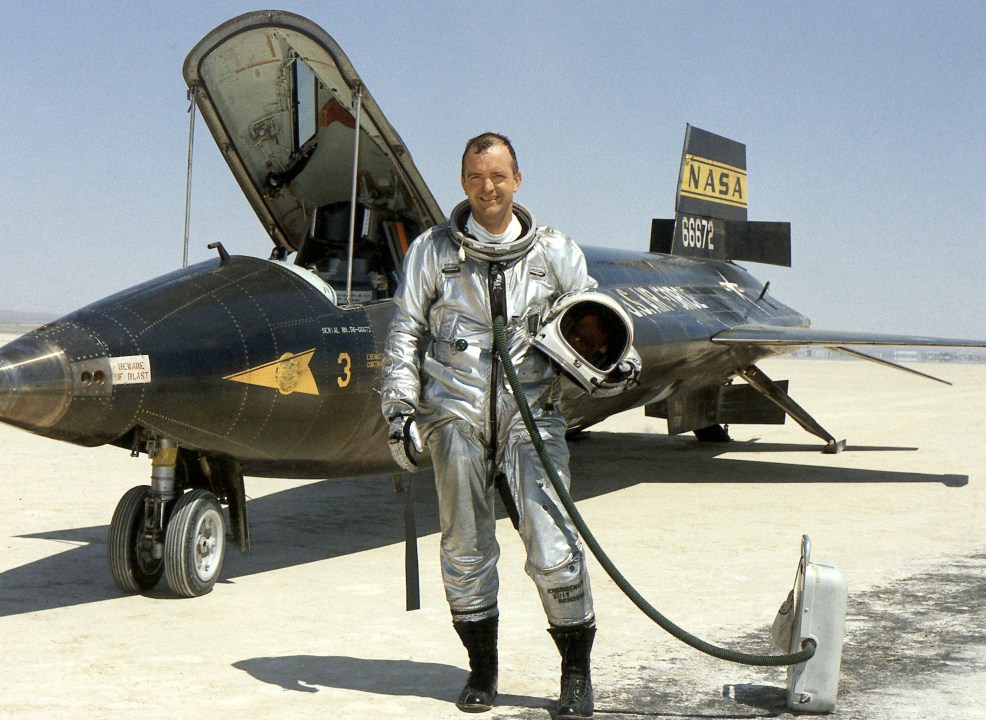
NASA research pilot Bill Dana poses in front of the hypersonic X-15 aircraft, October 24, 1967. Image courtesy National Aeronautics and Space Administration (NASA). (Photo by Smith Collection/Gado/Getty Images) 
Aerial view of the 3.5-Foot Hypersonic Tunnel Complex at the Ames Research Center, Moffett Federal Airfield, California, 1977. Image courtesy National Aeronautics and Space Administration (NASA). (Photo by Smith Collection/Gado/Getty Images) 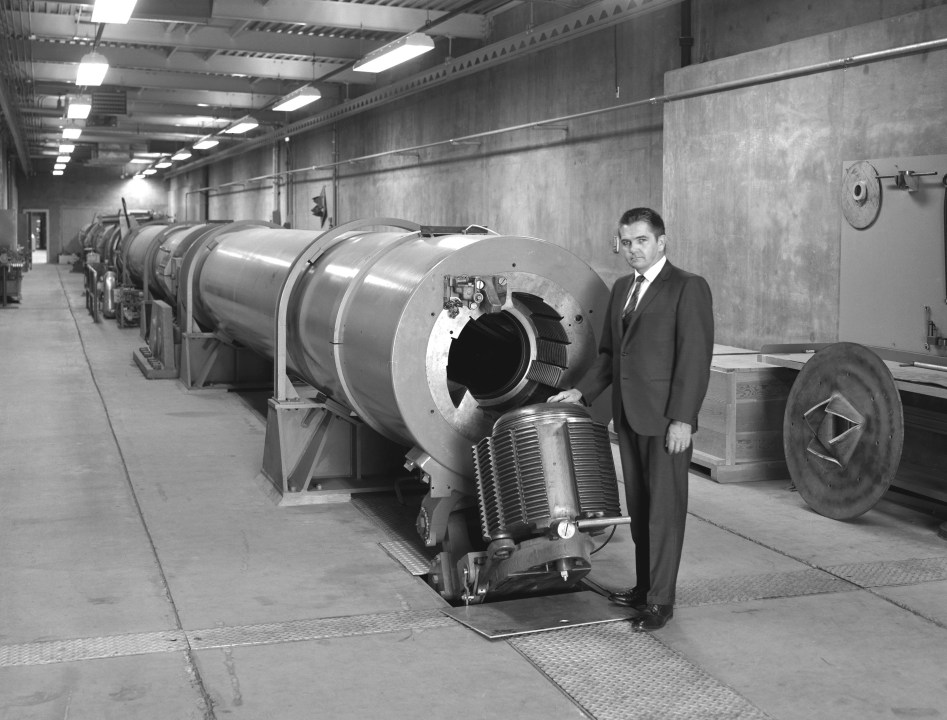
Branch Chief Thomas Canning stands beside a Hypersonic Free-Flight Aerodynamic Facility combustion-driven shock tube at Ames Research Center, Mountain View, California, 1966. Image courtesy National Aeronautics and Space Administration (NASA). (Photo by Smith Collection/Gado/Getty Images) 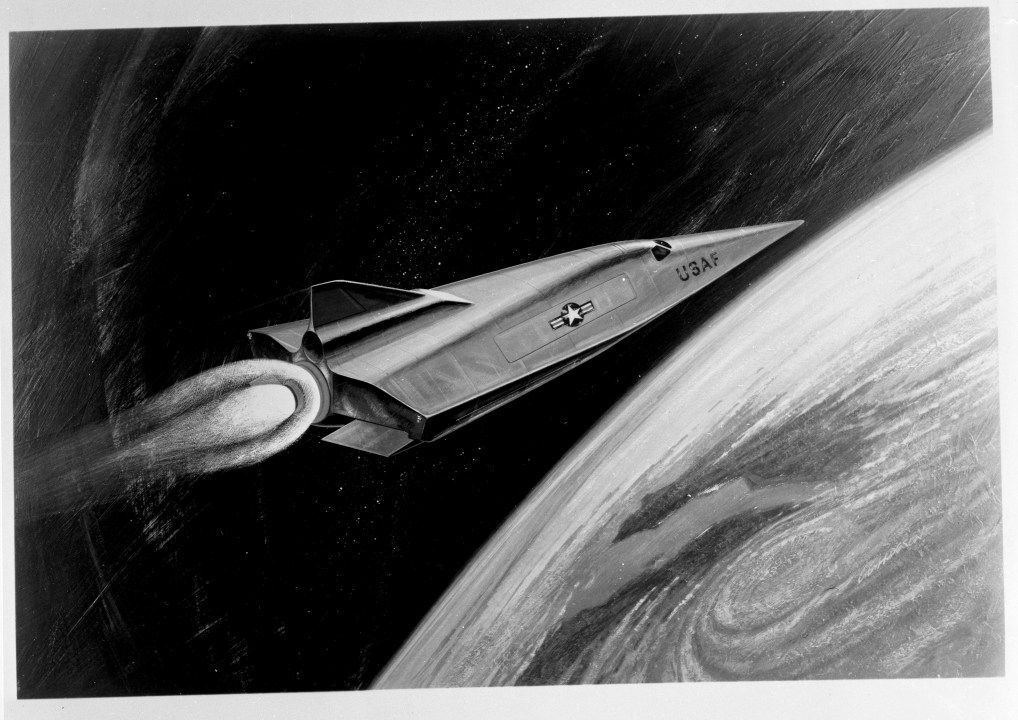
(Original Caption) This artist’s rendering illustrates the advanced hypersonic concept in entry vehicles achieved by Lockhead-California Company Engineers. The Fuselage is uniquely contoured to provide aerodynamic control in both high and low speed regimes. The design breakthrough eliminates the outer fins, which means that a smaller surface area is exposed to high temperature as the hypersonic craft flies back through the atmosphere and returns to earth for landing. 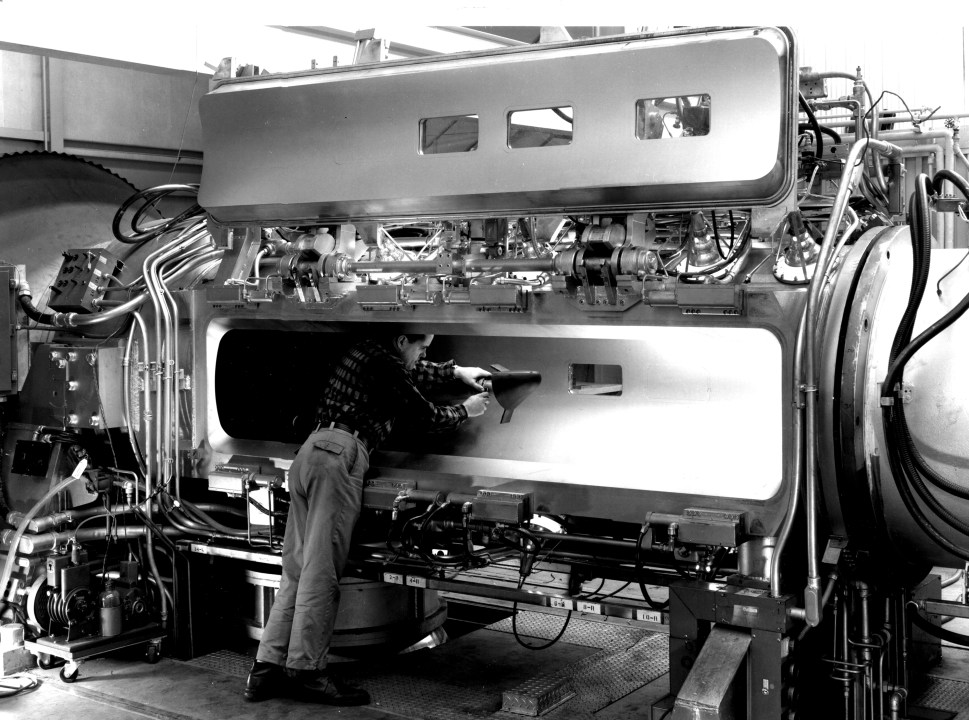
Photograph of the NASA engineer mounting the M-1 Lifting Body in the throat of the Hypersonic Tunnel at the NASA Ames Research Center, Mountain View, California, 1964. Image courtesy National Aeronautics and Space Administration (NASA). (Photo by Smith Collection/Gado/Getty Images)
According to NASA, the program completed its purpose of “supporting piloted hypersonic flight within and outside the Earth’s atmosphere.”
“The history of hypersonics is full of examples of successful programs that we have shut down prematurely, usually because of money,” Mark J. Lewis, president and chief executive officer of Purdue Applied Research Institute, told the Wall Street Journal.
China, Russia have hypersonic aircraft readily available
China and Russia have hypersonic aircraft readily available, which could alter the United States’ strategic plans, according to the Journal. These aircraft could be used to go around the early warning systems the U.S. has in place for detecting attacks. They could also be used to hit naval aircraft carriers and key bases.
In the South China Sea, even with the most advanced warship, the U.S. could still be defenseless against a hypersonic aircraft, the Journal reported. Hypersonic missiles could double Beijing’s reach, leaving U.S. ships defenseless, and could even strike Guam, where thousands of U.S. troops are stationed.
A former Pentagon senior official told the Journal that since the late 1960s, China has tested hypersonic flight at about ten times the rate of the U.S.