(NewsNation) — As Operation “Midnight Hammer” got underway Saturday, a group of B-2 bombers took off from their base in Missouri and were noticed heading out toward the Pacific island of Guam, in what experts saw as possible prepositioning for any U.S. decision to strike Iran.
But they were decoys.
Saturday night, President Donald Trump announced that three Iranian nuclear facilities were destroyed by bunker-busting bombers, and on Sunday morning, Pentagon officials provided a detailed breakdown of the operation.
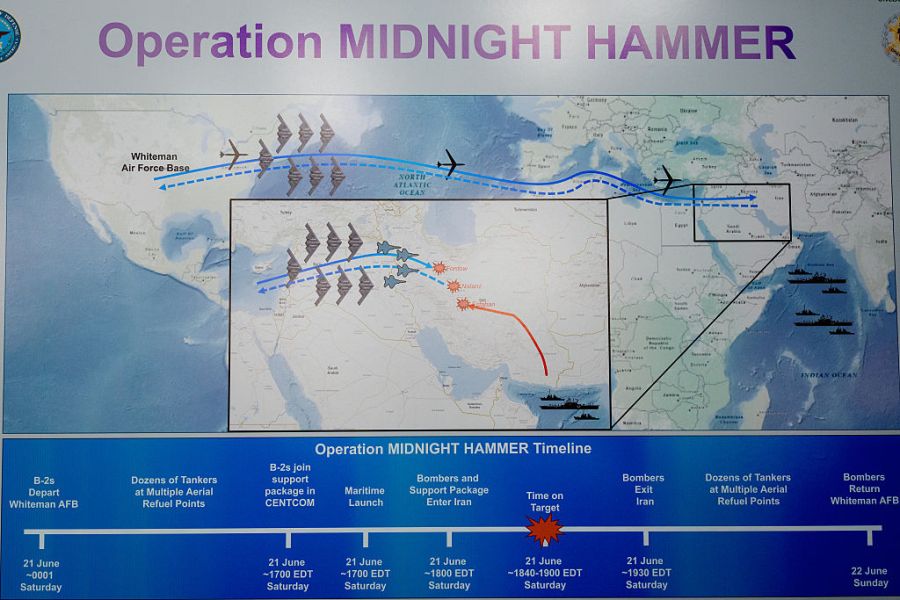
See the timeline below:
Decoys deployed at midnight
The B-2 bombers headed to Guam were decoys, according to Joint Chiefs of Staff chairman Gen. Dan Caine.
He said during a briefing Sunday that it was all “part of a plan to maintain tactical surprise” and that only “an extremely small number of planners and key leaders” knew about it in Washington and Florida, where U.S. Central Command is based.
The real group of seven bat-winged, B-2 stealth bombers took off from Whitman Air Force Base in Missouri and flew east undetected for 18 hours, keeping communications to a minimum, refueling in mid-air, the U.S. military revealed Sunday.
About an hour before the B-2s entered Iran, Caine said that a U.S. submarine in the region launched more than two dozen Tomahawk cruise missiles against key targets, including a site in Isfahan where uranium is prepared for enrichment.
A Pentagon-provided map of the flight path taken by B-2 stealth bombers indicates that their approach to Iran took them over the Mediterranean and then over Israel, Jordan and Iraq.
Bombers enter Iranian airspace
At about 5 p.m. ET Saturday, the bombers neared Iranian airspace, and a U.S. submarine launched more than two dozen Tomahawk land attack cruise missiles. U.S. fighter jets flew as decoys in front of the bombers to sweep for any Iranian fighter jets and missiles.
The B-2 bombers dropped 14 bunker-busting bombs, each weighing 30,000 pounds. The operation involved over 125 U.S. military aircraft, according to the Pentagon.
The U.S. struck the nuclear sites at Fordow and Natanz.
The Fordow site received the bulk of the bombardment, though a couple of the enormous bombs were also dropped on a uranium enrichment site at Natanz.
The U.S. bombs fell for about half an hour, with cruise missiles fired from submarines being the last American weapons to hit their targets, which included a third nuclear site at Isfahan, Caine said.
Both Iran and the U.N. nuclear watchdog said there were no immediate signs of radioactive contamination around the sites.
At around 7:30 p.m. ET, the bombers left Iranian airspace and began their flight back to the United States.
Iranian nuclear sites ‘completely and fully obliterated’
At about 10 p.m. ET Saturday, President Donald Trump made a televised address from the White House announcing that the combination of strikes “completely and fully obliterated” three Iranian nuclear sites. However, U.S. defense officials said an assessment of the damage wrought by the attack still was ongoing.
The Associated Press contributed to this story.