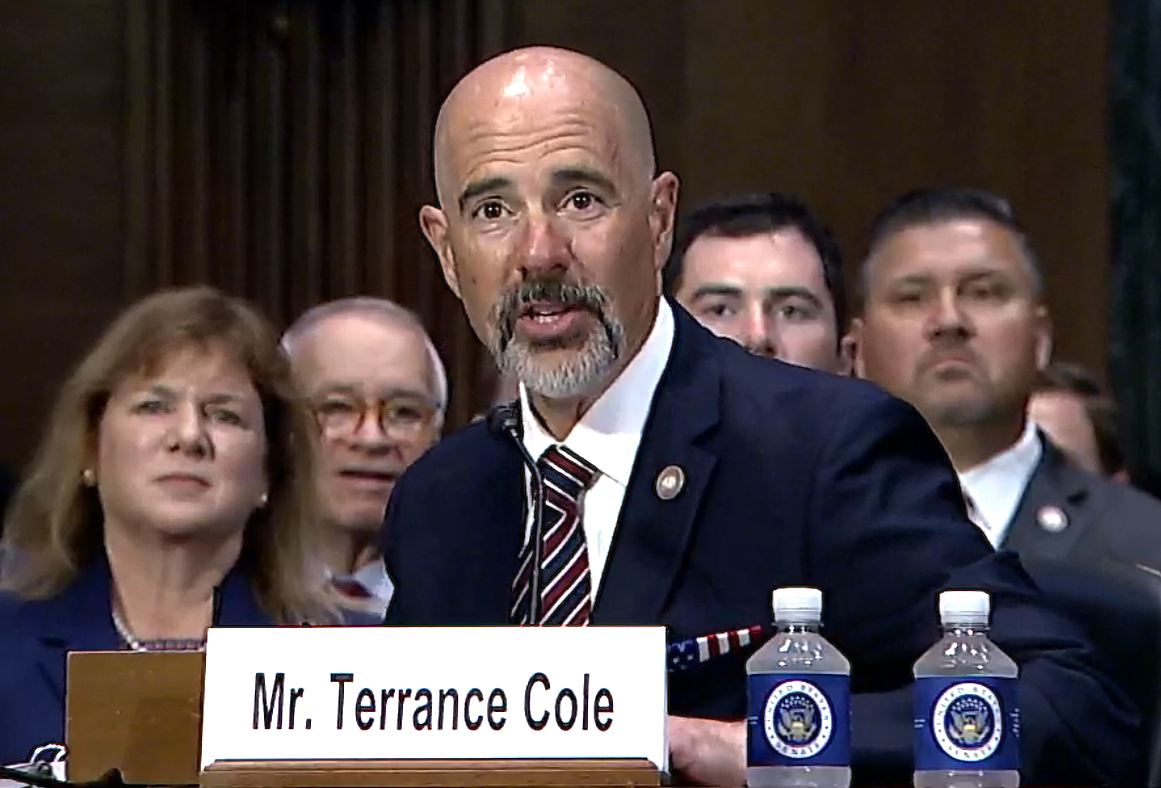
EL PASO, Texas (Border Report) – President Trump’s nominee to lead the Drug Enforcement Administration appeared this week before the Senate Judiciary Committee.
What Terrance Cole had to say appeared to leave some committee members cold and might add fuel to the fire of an already tense U.S.-Mexico relationship.
“What percentage of the country of Mexico would you say is dominantly governed by cartels?” asked committee member U.S. Sen. Lindsey Graham, R-South Carolina.
“I would say a majority,” Cole responded at the hearing. “I left DEA in 2019 from Mexico City and saw the dominance the cartels had at that time. (The Jalisco New Generation Cartel) controlled 24 of the states in Mexico.”
Graham stopped him to emphasize the point.
“You’re telling us that our neighbor in Mexico, when it comes to law enforcement and other activities, is pretty much controlled by cartels?” Graham asked.
“They work hand in hand. Yes, sir,” Cole responded.
Graham has long pushed for more cooperation from Mexico and a more decisive law enforcement response from the United States when it comes to stemming the flow of fentanyl and other drugs coming across the Southwest border.
In 2023, he said the U.S. should unleash its fury and might against the cartels.
Mexican leaders have long taken umbrage at suggestions from American politicians that their country is run by criminals. President Claudia Sheinbaum last February told them “start with your country.”
“Of course we will coordinate and cooperate, but never subordinate,” Sheinbaum said. “They have a lot to do in the United States. What happens after the drug crosses the border? Who distributes the drug, who sells the drugs that have provoked this tragedy in the U.S.? Where does the money from the sale of those drugs go in the United States.”
U.S. Sen. Richard Blumenthal, D-Connecticut, was among 43 members of Congress that last January urged the U.S. Supreme Court to hold American gun manufacturers accountable for the flow of guns into Mexico – an issue dear to the Mexican government. Mexico in 2022 sued major U.S. gun makers for negligence in allowing their weapons to reach Mexico and be utilized in thousands of murders.
At Wednesday’s hearing, he appeared taken aback by Cole’s statements.
“Frankly, I am somewhat surprised by your claim that the influence of those cartels is so rampant and powerful, even in the current government in Mexico,” Blumenthal said.
He called the statements a “pretty serious accusation” and asked for evidence.
Cole, a 20-year veteran of the DEA, said there’s consistent evidence of the collusion based on court cases, including that of former Mexican Public Safety Secretary Genaro Garcia Luna. Mexico’s top cop from 2006 to 2012 was sentenced last year in U.S. District Court for the District of Eastern New York to 38 years in prison for cooperating with the Sinaloa cartel in exchange for millions of dollars in bribes.
Cole stood by his testimony but expressed optimism things could change under Sheinbaum, who took office last October.
“We’ve seen traditionally the military working hand in hand, police officers working hand in hand with cartel members,” Cole said, adding that the current president of Mexico “has a lot of good will faith and is trying to change things based on some of the leadership roles she has appointed, especially (Public Safety Secretary) Omar Garcia Harfuch.”
Garcia Harfuch survived an assassination attempt by the Jalisco cartel in 2020.
The DEA administrator nominee told senators the United States continues to face an unprecedented crisis with some 300 Americans dying every day of drug overdoses. “If confirmed, my priority will be combatting this crisis with urgency and resolve. Cartel-driven devastation is affecting our communities,” he said.
Cole told senators he would push for more cooperation from Mexico to jointly and lawfully monitor cartel leaders’ activity and seize their assets. He also said education and prevention in the United States is crucial to cutting down on fentanyl deaths because many young people and parents are still not aware it is potentially deadly.
He also vowed to push for more accountability from China, a country long blamed by U.S. authorities for providing the precursor chemicals for the Mexican cartels to manufacture the fentanyl they export America.
Cole said Chinese criminal organization operatives are known to be present in Sinaloa — home to the Sinaloa cartel — and in Jalisco.
The date for Cole’s formal confirmation hearing is pending.
Nominee denies sharing intelligence that led to foreign massacres
Senators quizzed Cole on two incidents involving alleged mishandling of U.S. intelligence by foreign government officials. Each led to massacres of police officers in Colombia in 2006 and of Mexican civilians in 2011.
The one in Colombia involved officers serving a search warrant on a house where they expected to find cocaine. Soldiers on the payroll of a Colombian cartel were waiting for them and killed 10.
U.S. Sen. Chuck Grassley, R-Iowa, asked Cole to comment on recent CNN reports questioning if he had a role in intelligence sharing that ended up in the wrong hands abroad.
Cole on Wednesday publicly addressed the issue.
“The incident in 2006 was an operation conducted by the Colombian National Police. DEA had no involvement; DEA was not on the ground; DEA did not provide intelligence,” Cole said under oath. “The Colombian National Police operate in complete sovereignty in their country and were following through on information that was developed by (them) to serve a search warrant that was authorized by a Colombian prosecutor.”
Several members of the Colombian army allegedly paid by the Norte del Valle cartel to kill the policemen were later found guilty of the murders and are still in prison.
CNN and other news organizations have linked alleged DEA intelligence to the massacre of dozens – possibly hundreds – of Mexican residents in Allende, Mexico, in 2011.
U.S. officials reportedly had been given the cell phone numbers of the two principal leaders of the Zetas cartel in Mexico. That information allegedly was shared with Mexican police officers who alerted brothers Miguel Angel and Omar Trevino Morales.
The Zetas descended on the town which was one of their hideouts and started killing people while looking for the snitch, ProPublica reported.
“Did you directly transfer the intelligence to the Mexican authorities?” asked Committee Chair U.S. Sen. Chuck Grassley, R-Iowa.
“No, sir. I did not,” Cole said.
“Did you follow all DEA policies and get all proper supervisory approvals regarding the handling of the intelligence?”
“Yes, sir. We did.”
“Were you ever investigated or accused of any wrongdoing?”
No, sir. I was not.” Cole told the committee both Trevino brothers are now in U.S. federal custody after Mexico “extradited” them earlier this year.