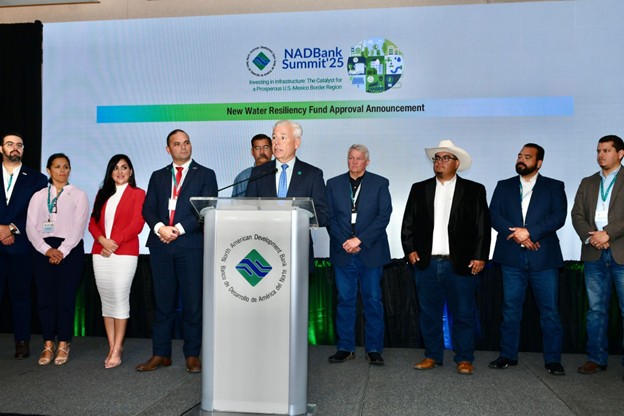
McALLEN, Texas (Border Report) — The North American Development Bank (NADBank) on Friday announced a $400 million Water Resiliency Fund designed to boost water conservation and alternative sources of water for the U.S./Mexico border region.
The funds are available for farmers, ranchers, municipalities and water districts on both sides of the border. And it comes after NADBank last year told Border Report that the binational bank planned to invest in more border conservation and diversification projects.
“Today’s check is pretty big from NAD bank. It’s a pretty big investment,” U.S. Rep. Tony Gonzales, R-Texas, said.

“In parts of South Texas, water is life. And to have an organization like NADBank go out there and make a significant investment that not only helps the United States, but also helps our neighbors and partner, Mexico, is absolutely critical and fundamental,” said Gonzales who was
at NADBank’s 2025 Summit in San Antonio to help announce the funds.
NADBank Managing Director John Beckham said the Water Resiliency Fund (WRF) will provide up to $400 million in financing for priority infrastructure projects aimed at conserving and diversifying water supply sources in the U.S.-Mexico border region.
This includes desalination plans, technology for municipalities and water districts to re-use storm water runoff, and projects with irrigation districts to reduce water loss, the binational bank says.
The goal is to develop new water sources and for the border region to not rely so much on the dwindling Rio Grande, which is not meeting the growing border’s water needs.
“Our goal is to enhance the capacity of the region, private and public sector farmers and cities to optimize this precious resource,” Beckham said.
Last year, Texas’ only sugar mill shut down in Santa Rosa, in Hidalgo County, causing 500 job losses, because of a lack of water for Rio Grande Valley farmers to grow the thirsty crops.
Hidalgo and Cameron counties both declared water emergencies and the issue became a top priority in the Texas Legislature’s general session this year.
The fund will match up to 50% of investment costs and offer $300 million in below-market loans, and up to $100 million in grant funding.
Beckham said they met with leaders from throughout South Texas — including Cameron County Judge Eddie Trevino, and Hidalgo County Judge Richard Cortez — as well as irrigation district managers in the Lower Rio Grande Valley to come up with this fund.
“This initiative is designed to catalyze investment in strategic infrastructure that improves the region’s water resilience through more efficient usage and diversification of sources, all of which will bolster our ability to withstand droughts and extreme weather events,” Beckham said.
The funds come as Mexico is approaching an October deadline to pay the United States 1.75 million acre-feet of water via the Rio Grande, though it is doubtfull they’ll be able to do.
Due to drought, overpopulation and poor infrastructure, Mexico has so far paid the United States just over 756,000 acre-feet of water, as of Aug. 23, according to the U.S. Section of the International Boundary and Water Commission.

Several Mexican officials on Friday were at the conference and praised the new water funds.
“It is certainly one of the best financing strategies for the water infrastructure needed on both sides of the U.S./Mexico border. We share the same desert and the same extraordinary drought conditions we have been enduring,” said Mario Mata, executive director of Chihuahua State Water and Wastewater Board.
Raul Quiroga, secretary of the Water Resources for Social Development for the northern Mexican state of Tamaulipas says it’s “critical” to the binational basin.
“The Water Resiliency Fund is an instrument that will allow us to implement water infrastructure projects on both sides of the border, which will undoubtedly help achieve more efficient water use, particularly among major users such as irrigation districts and municipal water systems, which will support efforts to address the deficit we have in the Rio Grande basin,” Quiroga said.
He also praised Mexican President Claudia Sheinbaum for her commitment to improve Mexican water infrastructure. He said she has pledged that Mexico will invest $7.164 billion in pesos (over $384 million in U.S. dollars) to improve water conservation and technology in border irrigation districts of Bajo Río Bravo, which is in Tamaulipas and oversees water through Falcon Dam and Anzalduas Canal, as well as Bajo Río San Juan, that includes Monterrey, in the state of Nuevo León, and the Coahuilla, which borders Eagle Pass, Texas and the Big Bend area.
Beckham said the new WRF also will work with legislation passed by Texas lawmakers this year that will help smaller utilities collaborate to build regional infrastructure to maximize water plans.
A full list of NADBank financed projects can be found at this link.
Sandra Sanchez can be reached at SSanchez@BorderReport.com.