(NewsNation) — News that scientists have found potential evidence of life on a faraway planet is exciting but shouldn’t be taken as a certainty that life exists there, says investigative journalist and podcaster Ross Coulthart, who studies UFOs and claims of alien visitations.
Scientists at the University of Cambridge say they have detected what could be chemical signs of life on a planet known as K2-18b, which is 124 light-years away from Earth. They say they came to their conclusion by analyzing data from the James Webb Space Telescope.
Specifically, the researchers say dimethyl sulfide and dimethyl disulfide appear to be present in the atmosphere of K2-18b, which orbits a star. The compounds are produced primarily by microbial life, such as marine phytoplankton, on Earth.
But Coulthart said, “One of the reasons some scientists are urging caution is because there may be a non-organic reason for why this stuff is there.” Coulthart is among the observers who find the information encouraging but well short of a firm conclusion.
Ross Coulthart: ‘We are on the cusp of finding planets that are habitable’
“It’s a big deal, but it’s still very, very tentative,” Coulthart told “NewsNation Prime” on Sunday. “There are doubters and debunkers.”
Still, he said, it’s notable that scientists can interpret data generated by the Webb Telescope.
“I really do think we are on the cusp of finding planets that are habitable for life,” Coulthart said.
As for getting closer to confirm whether K2-18b has life, that’s not realistic, he said.
“There’s no way we can send a robotic drone there because it would take billions of lifetimes to get there,” Coulthart said. “There’s no really solid way of proving it beyond doing more accurate measurements of the wavelengths of light.”
What is K2-18b?
K2-18b is an exoplanet that is nearly nine times the size of Earth, according to NASA. K2-18b is a Hycean exoplanet since it has the potential of possessing a hydrogen-rich atmosphere and an ocean-covered surface. It was found in 2015, according to USA TODAY.
In 2019, NASA’s Hubble Space Telescope found water vapor on K2-18b for the first time. The potentially habitable planet orbits a cool dwarf star named K2-18 in what NASA calls the “habitable zone.” Since these planets are over 120 light-years away from Earth and in the Leo constellation, it is hard for scientists to study them.
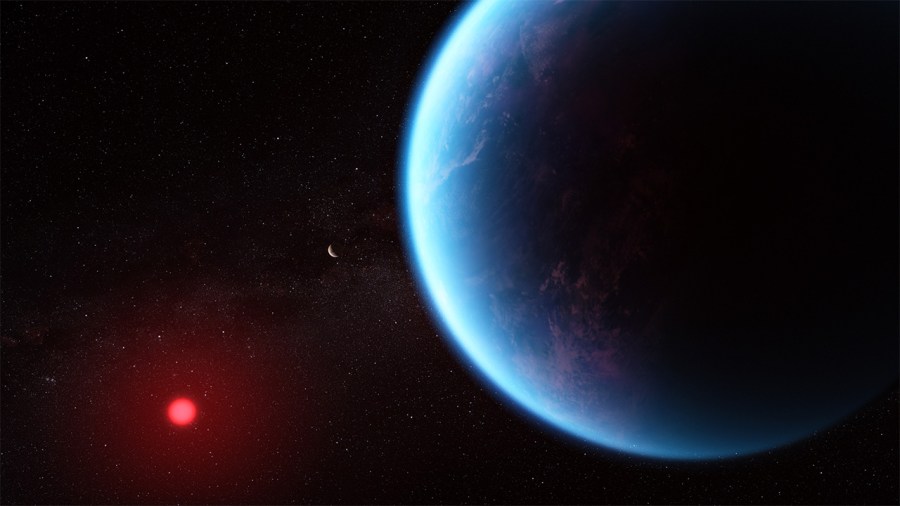
In 2023, scientists found “the presence of carbon-bearing molecules, including methane and carbon dioxide,” on the planet. As for the recent discovery, Coulthart said the James Webb Space Telescope will be doing some follow-up research.
Scientists have been able to confirm more than 5,500 planets that orbit other stars. The James Webb Space Telescope is the biggest and most powerful observatory that we have ever sent into space.
The Associated Press contributed to this report.