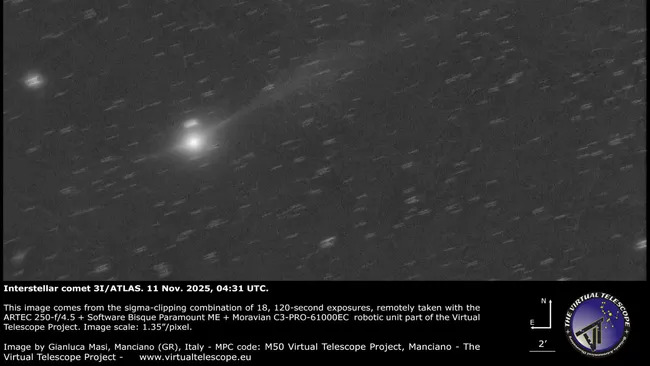
(NewsNation) — A new photo of interstellar comet 3I/ATLAS shows that its tail has grown longer and more structured as it continues its space journey.
The Virtual Telescope Project took the most recent photo of the comet and its ion tail Monday. An ion tail forms when the sun’s ultraviolet radiation takes electrons from gas molecules released by the comet, which turns them into charged ions.
Those ions are later swept away by solar winds and create a long tail that points away from the sun regardless of where the comet is traveling. 3I/ATLAS’s tail, however, appears to be curving along its orbital path, unlike other comets.
Physicist Avi Loeb, who has tracked 3I/ATLAS’s movements for months, told NewNation’s Elizabeth Vargas the comet’s tail was untraditional, along with its unusual trajectory through the Milky Way and its large size.
“It’s at least a thousand times more massive than the previous interstellar objects we’ve seen,” Loeb said. “And the question is, why is such a giant object delivered to our inner solar system, when we saw only small ones before?”
Loeb told NewsNation on Monday he saw what appeared to be seven jets coming out of the comet during its orbit past the sun.
The name 3I/ATLAS derives from the fact that it’s the third known interstellar object to enter our solar system and that it was discovered by the Asteroid Terrestrial-impact Last Alert System.
3I/ATLAS will likely pass Earth in December.