(NewsNation) — Astrophysicists have long marveled at the massive jet of hot plasma streaming from a black hole in the center of the galaxy known as M87, but now they’ve got a sharper view of what’s happening 55 million light-years from Earth.
A group of scientists recently unveiled a striking new photograph they composited from images captured by the James Webb Space Telescope last year. By zeroing in on the infrared scale, the team was able to reveal a more detailed look at the jet, which resembles a sort of cosmic blowtorch — albeit one that is 3,000 light-years long.
This new view even shows a hint of the long-elusive counter-jet that shoots in the opposite direction from the black hole’s center.
“With every new observation, we inch closer to the complete picture,” Jan Röder, an astrophysicist at the Institute of Astrophysics of Andalusia in Spain, told Live Science. Röder was among the researchers who worked on the M87 project.
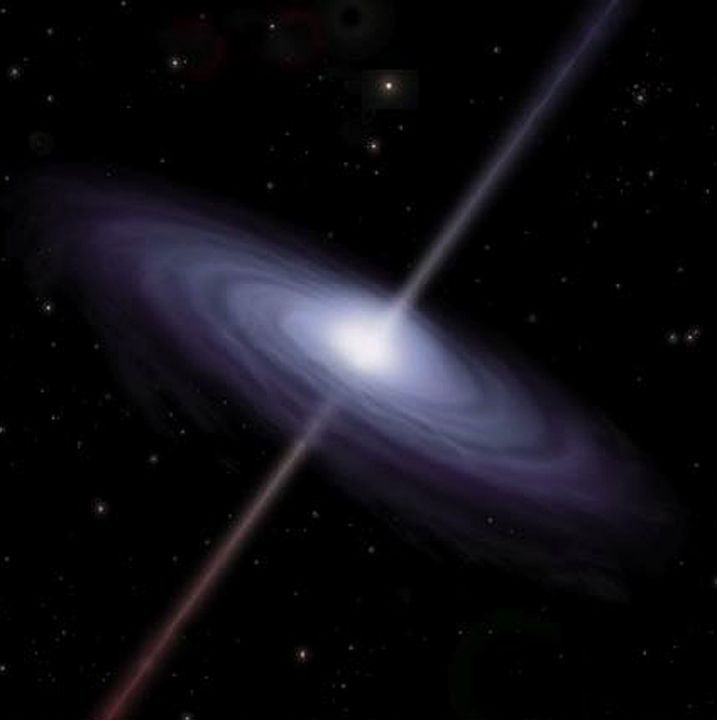
What is a black hole jet?
A black hole jet occurs when gravity pulls gas and dust — flattened into a rotating “accretion disk” of matter — into the event horizon. Through acceleration and friction, highly energized particles are ejected from the black hole in a stream that is hotter than the sun and traveling near the speed of light.
French astronomer Charles Messier is credited with discovering the elliptical galaxy of M87 — or Messier 87 — in 1781. The discovery of the black hole jet came much later, in 1918, when Michigan astronomer Heber Curtis noticed a “curious straight ray” coming from the center of the galaxy.
It’s considered the first discovery of an extragalactic jet.