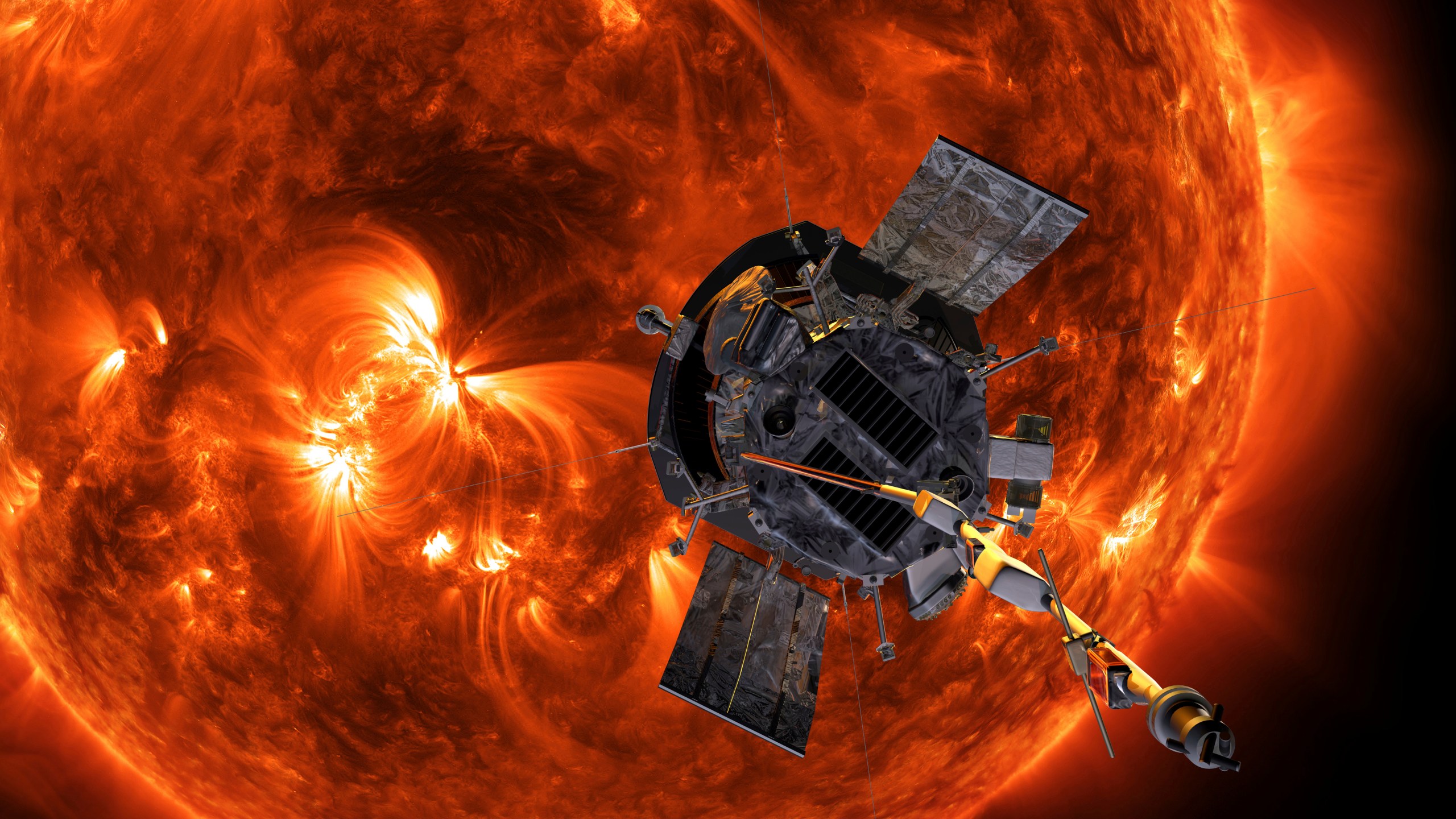
(NewsNation) — NASA’s Parker Solar Probe has successfully made the closest approach to the sun, the space agency announced Friday.
Earlier this week, the spacecraft passed within a record-breaking 3.8 million miles (6 million kilometers) of the scorching star. NASA received an all-clear message from Parker on Thursday night confirming it survived the journey.
Launched in 2018 to get a close-up look at the sun, Parker has since flown straight through its crownlike outer atmosphere, or corona. With its close brush complete, the craft is expected to circle the sun at this distance through at least September.
It’s the fastest spacecraft built by humans and hit 430,000 mph (690,000 kph) at closest approach. It is outfitted with a heat shield that can withstand scorching temperatures up to 2,500 degrees Fahrenheit (1,370 degrees Celsius).
The agency said the operations team at the Johns Hopkins Applied Physics Laboratory in Maryland received the signal, a beacon tone, from the probe just before midnight Thursday.
NASA added the spacecraft is expected to send detailed telemetry data about its status Jan. 1.
The Parker Solar Probe has been gradually circling closer toward the sun since 2018, using flybys of Venus to gravitationally pull it into a tighter orbit with the sun.
The Associated Press and Reuters contributed to this report.