(NewsNation) — Pope Francis spent his final days celebrating Holy Week, the seven days leading up to Easter Sunday.
Francis, the 266th head of the Catholic Church, died Monday, the Vatican confirmed. His death came just one day after Easter and nearly a month since his release from a lengthy hospital stay.
Despite health concerns, Francis made several public appearances over the holiday and called for peace as he commemorated the most sacred time of the Christian calendar.
Pope Francis still visits inmates on Holy Thursday despite health concerns
The pope opened Holy Week celebrations April 13 with an in-person appearance in St. Peter’s Square. Francis, unaided by supplemental oxygen as he had been previously, wished more than 20,000 onlookers a “Happy Palm Sunday, Happy Holy Week.”
Francis spent Holy Thursday visiting Rome’s Regina Coeli prison, where he met with nearly 70 inmates. His health complications prevented him from washing the feet of 12 people — a reenactment of Jesus Christ’s acts to his apostles before his crucifixion.
He told the inmates he still wanted to be with them, however, and “do what Jesus did on Holy Thursday.”
On Good Friday, Francis opted out of attending an annual procession at Rome’s Colosseum, Reuters reported.
Pope Francis makes appearance at Easter Mass in St. Peter’s Square
Though Francis did not preside over the Easter Mass held in St. Peter’s Square on Sunday — it was delegated to Cardinal Angelo Comastri, the retired archpriest of St. Peter’s Basilica — he did make an appearance to bless believers.
Francis oversaw a Latin blessing from the basilica’s loggia balcony before taking a turn around the piazza in his popemobile.

Pope Francis wears the miter during the celebration for the closing of the Holy Door on Nov. 20, 2016. (Photo by Grzegorz Galazka/Archivio Grzegorz Galazka/Mondadori Portfolio via Getty Images) 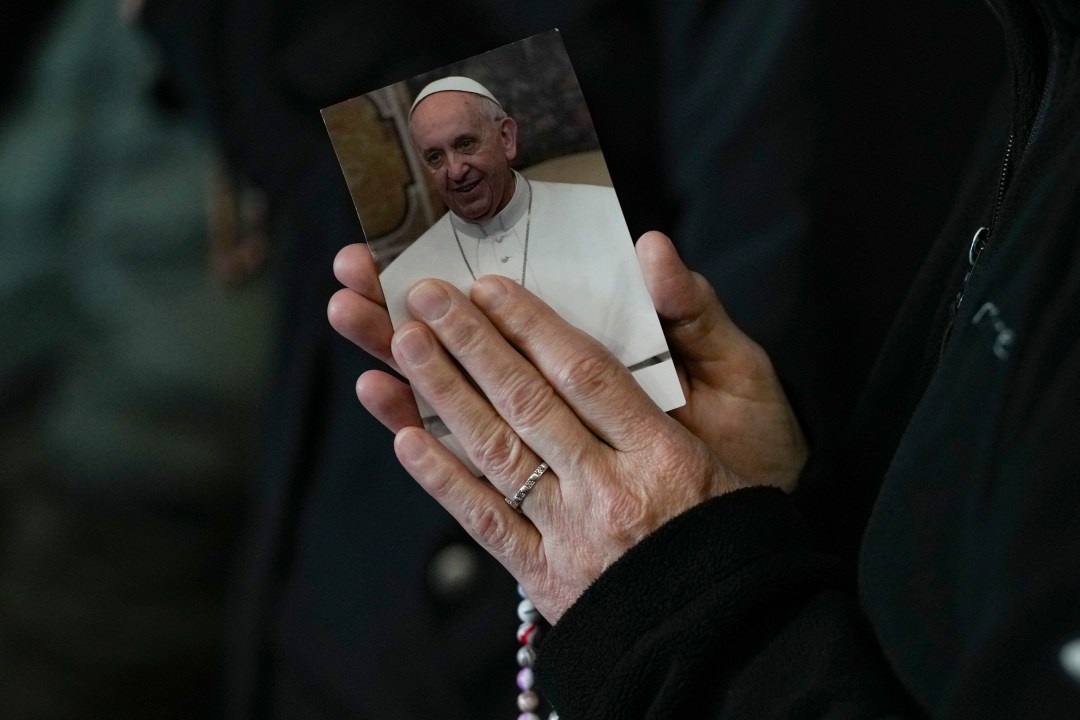
A nun attends a rosary prayer for Pope Francis in St. Peter’s Square at the Vatican on March 10. (AP Photo/Andrew Medichini) 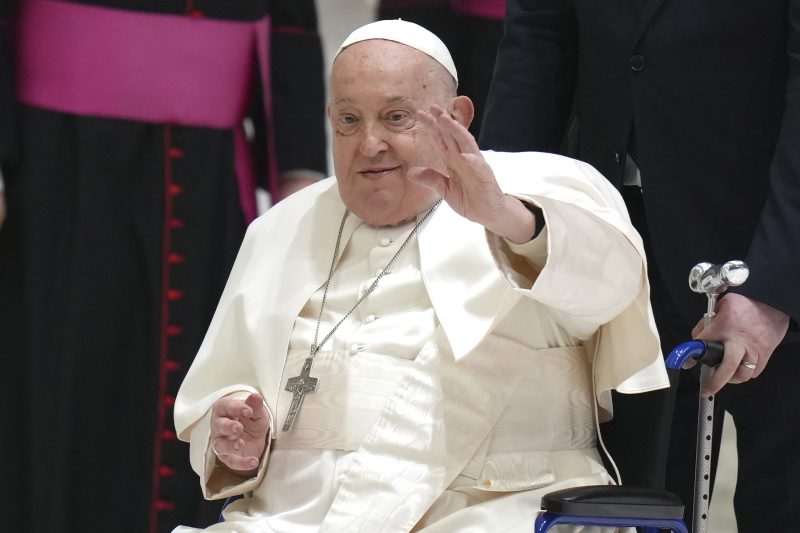
Pope Francis waves as he arrives for his weekly general audience in the Paul VI Hall at the Vatican on Feb. 12. (AP Photo/Alessandra Tarantino, File) 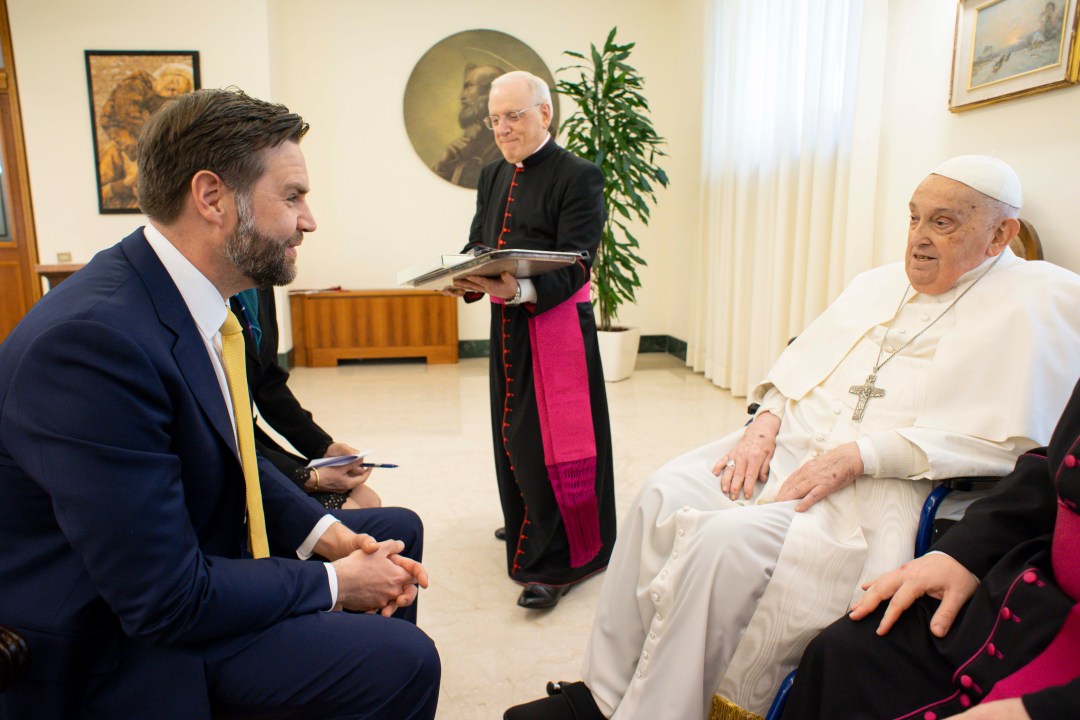
Pope Francis meets with Vice President JD Vance and delegation during an audience at Casa Santa Marta on April 20 in Vatican City, Vatican.
In a speech, read by Archbishop Diego Ravelli, master of liturgical ceremonies, Francis appealed for peace in Gaza and Ukraine, as well as Congo and Myanmar. He also advocated for mercy on the “vulnerable, the marginalized, and migrants.”
“I appeal to all those in positions of political responsibility in our world not to yield to the logic of fear, which only leads to isolation from others, but rather to use the resources available to help the needy, to fight hunger, and to encourage initiatives that promote development,” the speech read.
As Francis wished the bustling crowd a happy Easter, he was met with cheers of “Viva il papa!” (Long live the Pope) and “Bravo!”
On Sunday, Francis also met with Vice President JD Vance, a Catholic convert. The Vatican said the encounter lasted just a few minutes and was designed to allow for an exchange of Easter greetings.
In the wake of the pope’s death, Vance shared condolences on social media for the “millions of Christians all over the world who loved him.”
How will the next pope be chosen?
Francis’ death will now set off the formal process of choosing his successor. This is known as a conclave, which refers to the practice of Catholic cardinals gathering in a closed room or hall to vote on who should be appointed the next pope.
In 1271, political turmoil delayed the election of Pope Gregory X by more than two years. To ensure this wouldn’t happen again, Pope Gregory X promised that cardinals would stay together until a new pope was chosen.
The current practice includes cardinals being locked in at Domus Sanctae Marthae to vote. They cannot leave until a new pope has been decided upon.
Per the U.S. Conference of Catholic Bishops, the conclave usually occurs around 15 to 20 days after the death or resignation of a pope. The College of Cardinals, chosen by the pontiff, will attend Mass at the Vatican’s St. Peter’s Basilica and ask for guidance from the Holy Spirit on who to choose.
According to the U.S. Conference of Catholic Bishops, there is a limit of 120 cardinals who can vote. These individuals are called “the cardinal electors.” The results of the conclave are binding, and, while it doesn’t need to be a cardinal, it typically is.
A non-cardinal has not been elected pope since Pope Urban VI in 1378. During the first day of the conclave, all cardinals must vote. A pope can only be chosen if two-thirds of the cardinals agree.
Four rounds of voting with four ballots per day must be completed until this happens. If no one is elected after three days, voting will be paused for up to one day. Once a decision is made, the dean of the College of Cardinals will ask the individual if they accept. If they do, he will pick a papal name and be dressed in papal vestments.
After this, the new pope will go out on the balcony of St. Peter’s Basilica to greet people below.
The only requirements to be chosen as the next pope are that he must be a male and have been baptized into the Catholic Church. When a pope is selected, the black smoke from the Sistine Chapel will change to white, and the bells of St. Peter’s will be rung.
The Associated Press contributed to this report.