(NewsNation) — Cardinal Robert Prevost, an American, has been selected as the new pope and taken the name Leo XIV.
White smoke poured out of the Sistine Chapel chimney Thursday after Prevost secured at least 89 votes of the 133 cardinals participating in the conclave to succeed Pope Francis.
Prevost, 69, was born in Chicago and is the first American pope in the 2,000-year history of the Catholic Church. He spent his career ministering in Peru and recently led the Vatican’s powerful office of bishops.
Prevost was elevated to cardinal in January 2023 by Pope Francis and became the 267th leader of the Catholic Church after two days of deliberation.
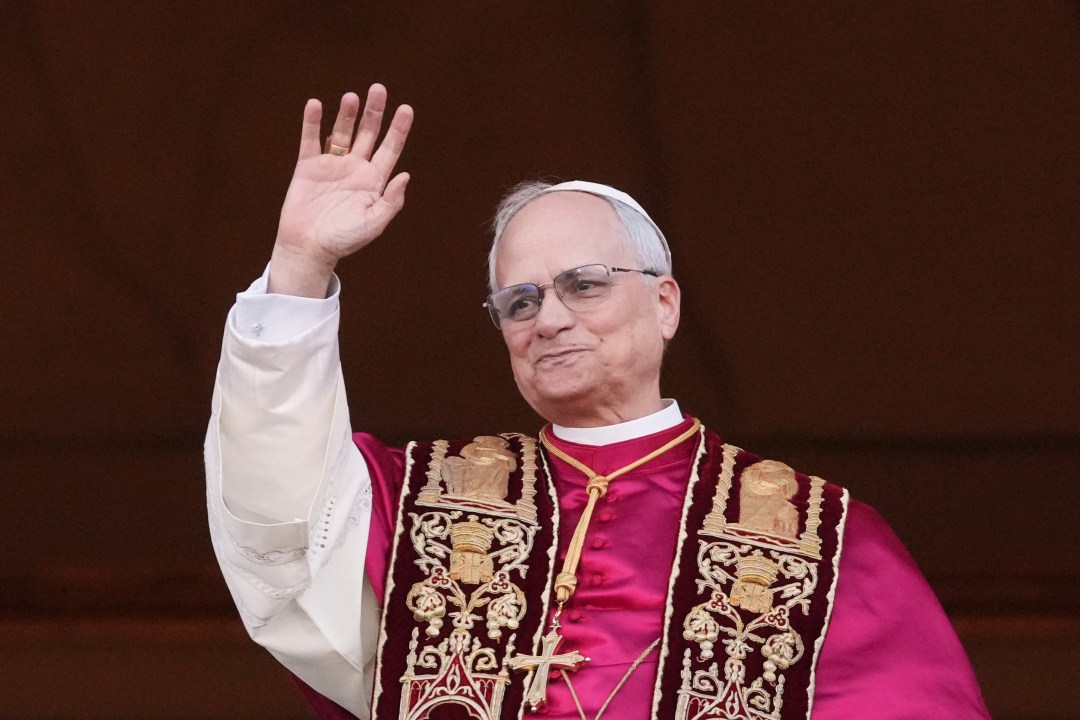
Appearing at the central window of St. Peter’s Basilica, the new pope’s first words were: “Peace be with you.”
Here’s what we know about Pope Leo XIV.
How did Robert Prevost become the pope?
Prevost was born on Sept. 14, 1955, in Chicago, Illinois.
The son of a U.S Navy veteran of World War II, Prevost grew up in Dolton, a south suburb of Chicago, according to the Chicago Sun Times. The Prevost family landed at the old St. Mary of the Assumption parish on 137th Street, where they were reportedly known as “dedicated and devout musicians, altar boys, lectors and volunteers.”
ABC News reported that the new pope is a Chicago Cubs fan, but Prevost’s brother John told WGN the pope is actually a fan of the South Siders — the Chicago White Sox.
In 1977, Prevost earned a bachelor’s degree in mathematics from Villanova University before continuing to the Catholic Theological Union of Chicago, receiving a diploma in theology.

Pope Leo’s visit to Providence Catholic High School in New Lenox, IL, in August, during which he celebrated a special Mass for the school’s Celtic community 
Pope Leo’s visit to Providence Catholic High School in New Lenox, IL, in August, during which he celebrated a special Mass for the school’s Celtic community 
Pope Leo’s visit to Providence Catholic High School in New Lenox, IL, in August, during which he celebrated a special Mass for the school’s Celtic community 
Pope Leo’s visit to Providence Catholic High School in New Lenox, IL, in August, during which he celebrated a special Mass for the school’s Celtic community 
Pope Leo’s visit to Providence Catholic High School in New Lenox, IL, in August, during which he celebrated a special Mass for the school’s Celtic community 
Pope Leo’s visit to Providence Catholic High School in New Lenox, IL, in August, during which he celebrated a special Mass for the school’s Celtic community
At the age of 27, Prevost was sent by the Order to Rome to study canon law at the Pontifical Saint Thomas Aquinas University (Angelicum). He was ordained as a priest in 1982.
Prevost is also a Peruvian citizen, where he lived for years, spending time as a missionary and later an archbishop.
Pope Francis brought Prevost to Rome in 2023 to serve as the powerful head of the office that vets bishop nominations from around the world, one of the most important roles in the Catholic Church.
Leo XIV speaks five languages — English, Spanish, Italian, French and Portuguese — and can also read Latin and German, according to the National Catholic Reporter.
What are Robert Prevost’s views?
Prevost is a member of the Augustinian religious order, making him the Roman Catholic Church’s first Augustinian pope, according to The New York Times.
A core value for the Order of St. Augustine is to “live together in harmony, being of one mind and one heart on the way to God.”
Prevost has kept a low public profile since arriving in Rome, but his actions offer some insight into his views. Notably, Prevost presided over one of the most revolutionary reforms Pope Francis made — adding three women to the voting bloc that decides which bishop nominations to forward to the pope.
In early 2025, Francis appointed Prevost to the most senior rank of cardinals — a sign he would at least be Francis’ choice in any future conclave.
In February, an X account allegedly belonging to Prevost posted a link to an opinion article titled, “JD Vance is wrong: Jesus doesn’t ask us to rank our love for others.”
Rev. Michele Falcone, 46, a priest in the Order of St. Augustine previously led by Prevost, described his mentor and friend as the “dignified middle of the road,” The New York Times reported earlier this month.
Prevost has reportedly said that “the bishop is not supposed to be a little prince sitting in his kingdom,” but instead a church leader is “called authentically to be humble, to be close to the people he serves, to walk with them, to suffer with them.”
When asked about gay clerics, Cardinal Prevost has expressed less welcoming views to LGBTQ+ people, according to The New York Times.
In a 2012 address to bishops, the Times said, Prevost lamented that Western news media and popular culture fostered “sympathy for beliefs and practices that are at odds with the gospel.”
Why is the name Pope Leo XIV important?
Once elected, popes choose a new papal name, which often reflects the values they intend to embody.
Prevost chose the name Leo, becoming the 14th pontiff to do so — a tradition that dates back to Pope Leo I, also known as Leo the Great, in the year 440.
The name Leo “is a deep sign of commitment to social issues. I think it is going to be exciting to see a different kind of American Catholicism in Rome,’’ Natalia Imperatori-Lee, the chair of religious studies at Manhattan University in the Bronx, told The Associated Press.
The most recent Leo, Pope Leo XIII, was an Italian who led the church from 1878 to 1903. He is remembered for softening Catholicism’s confrontational stance toward modernity and laying the foundation for modern Catholic social thought.
Most famously, Pope Leo XIII outlined the rights of workers to a fair wage and safe working conditions in his 1891 encyclical, “Rerum Novarum.” With that, he became known as the “Social Pope” and the “Pope of the Workers.”
Cristina Traina, a religious studies professor at Fordham University, told NewsNation that Prevost’s choice of name implies “continuity” with Pope Leo XIII and an interest in “social justice.”
Kurt Martens, who teaches at The Catholic University of America in Washington, told the AP that Prevost’s name choice also suggests continuity with the church’s direction under Pope Francis. He said references in Leo XIV’s speech to embracing the whole world suggest that the new pope will continue to focus on the poor and those on the margins of societies.
Why has there never been an American pope?
There’s never been an American pope until now, and that’s partly due to the power the U.S. wields in the secular sphere.
“The conventional wisdom was that there would not be an American pope because of geopolitical implications,” Prof. Bruce Morrill of Vanderbilt University told the AP.
Morrill, a Jesuit priest, echoed others’ remarks about Prevost’s choice of name, saying, “This is a man also very concerned about the church serving the greater social needs of the world.”
Daniel Wakin at The New York Times speculated that perhaps the United States’ shrinking role in the world made Thursday’s decision possible.
“Maybe a time of waning American presence in the world opened the door to an American pope,” Wakin wrote in an opinion.
Today, roughly 20% of U.S. adults describe themselves as Catholics — a share that has remained largely stable over the past decade, according to the Pew Research Center.
Notably, the first U.S. pope didn’t use English in his first speech.
President Trump spoke to reporters outside the West Wing on Thursday, saying that for the new pope to be American, “What greater honor can there be?”
“We’re a little bit surprised and we’re happy,” Trump added.
The Associated Press contributed to this story.