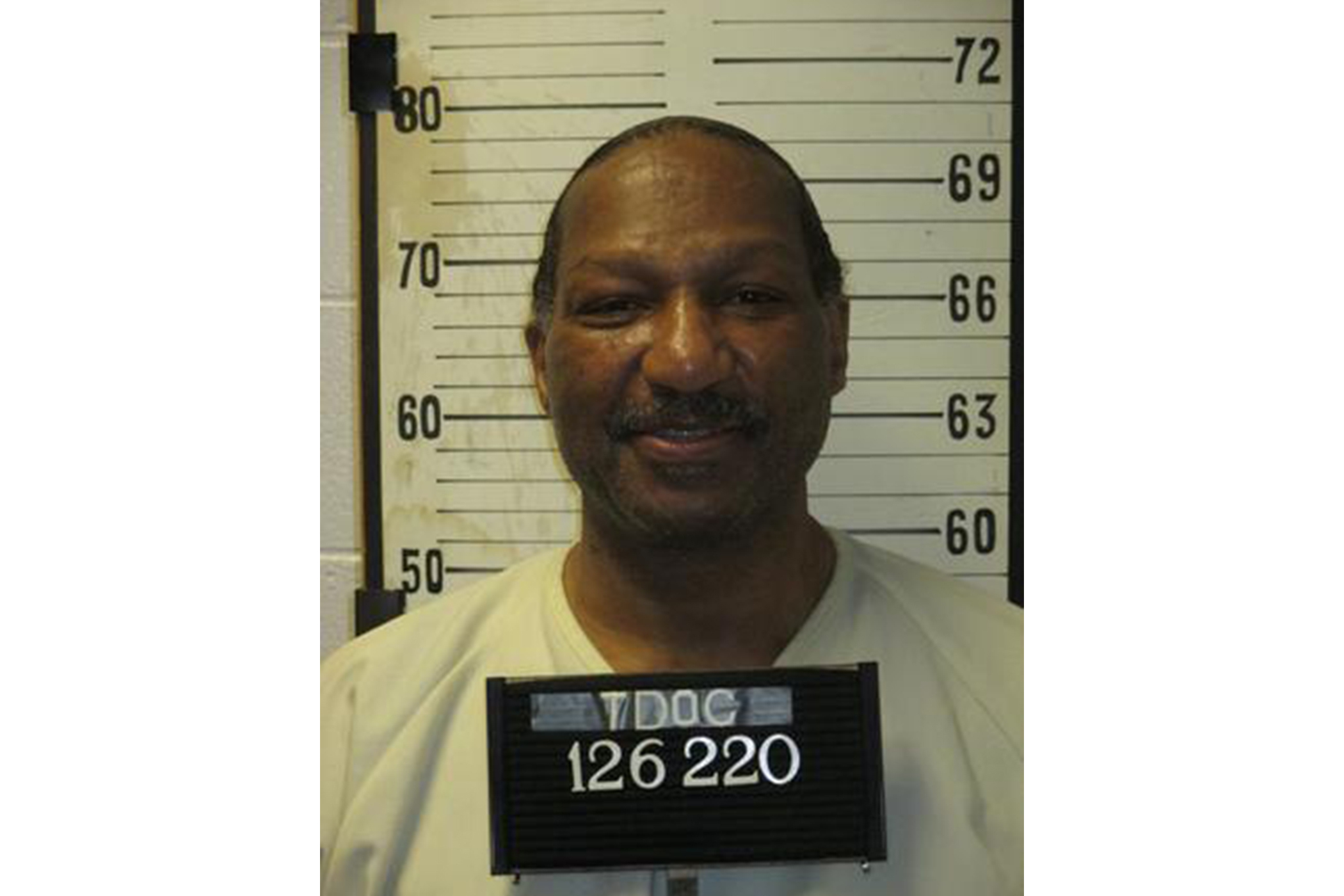
(NewsNation) — A Tennessee inmate is scheduled to be put to death next week despite his intellectual disability and concerns over how his heart defibrillator could prolong the execution.
The execution of Byron Black, who has been on death row since 1989, has been surrounded by a peculiar set of ethical dilemmas that his lawyers say warrant a stay on the scheduled killing.
At least one of those dilemmas was addressed by the Tennessee Supreme Court on Thursday, which ruled that Black can be given a lethal injection of barbiturate pentobarbital while implanted with an active heart-regulating device.
Black’s attorneys have appealed to the U.S. Supreme Court, which has not yet stepped in.
Kelley Henry, Black’s attorney, has said she would also petition Tennessee Gov. Bill Lee to grant clemency so that “Tennessee does not move forward with this gruesome spectacle.”
Black was convicted in the 1988 shooting deaths of his girlfriend Angela Clay, 29, and her two daughters, Latoya Clay, 9, and Lakeisha Clay, 6. Prosecutors said he was in a jealous rage when he shot the three at their home. At the time, Black was on work release while serving time for shooting Clay’s estranged husband.
Tennessee Attorney General Jonathan Skrmetti has vowed to move forward with the execution, saying in a statement that he “will continue fighting to seek justice for the Clay family and to hold Black accountable for his horrific crimes.”
Black’s defibrillator will activate to keep him alive during his execution
Black has an implanted pacemaker-defibrillator, and his lawyers have argued for it to be deactivated before the execution.
An implantable cardioverter-defibrillator, also called an ICD, is a small battery-powered device placed in the chest. It constantly checks the heartbeat and delivers electric shocks if it detects an irregular heartbeat.
A lower court judge had ruled that the implanted cardioverter-defibrillator is likely to continuously shock Black’s heart, causing unnecessary pain and prolonging the execution, and ordered the state to deactivate the device shortly before the execution.
The Tennessee Supreme Court overruled the decision, finding that the requirement of having the device deactivated “amounted to a stay of execution,” which is not within the lower court’s power.
The state’s high court kept in mind the possibility that Black could win an 11th-hour appeal, saying that deactivating it too far in advance might mean he could die just before a ruling that would have saved him.
The ruling also left open the possibility that the state could deactivate the device if they do it in a way that does not interfere with the execution.
The Tennessee Attorney General’s office has said that a hospital they requested to deactivate the defibrillator was unwilling to take part in the procedure. Most medical professionals consider any participation in executions to be a violation of medical ethics.
That muddies the matter further because even if both sides were to agree to a deactivation plan, it’s unclear if they would be able to find a health professional to undertake the task.
After Thursday’s ruling, Black’s attorneys filed a motion for a stay of execution with the state Supreme Court. It says Black deserves a stay for the limited time needed for his attorneys and the state to resolve the defibrillator issue or for the state Supreme Court to consider Black’s request for the device to be disabled.
The state Supreme Court’s ruling did not address the issue of whether Black’s defibrillator will continuously shock his heart or whether that would cause unnecessary suffering, in violation of the state and federal constitutions.
Black has been declared intellectually disabled
The state of Tennessee has declared Black intellectually disabled as his IQ has been recorded between 57 and 76.
According to Black’s attorneys, no court has fully evaluated these scores or his documented deficits in adaptive functioning. The inmate also has severe dementia and significant brain injury.
If the execution goes forward, he would become the first person in Tennessee with an intellectual disability to be executed, his lawyers said.
Black’s attorneys had argued he should be spared under a 2021 law that made Tennessee’s prohibition against executing people with intellectual disability retroactive. They argued that there is a different standard in place now than in 2004 when the court found that Black didn’t meet the now-obsolete definition of “mental retardation.”
The court ruled, however, that the state law does not apply to death row inmates who had previously received a ruling from a prior court.
Black’s execution postponed multiple times
Black would be put to death by lethal injection after Tennessee resumed executions this year after a nearly five-year break.
He will be the second person to be executed after Oscar Franklin Smith was put to death in May.
Black’s execution has been delayed multiple times over the years due to several reasons, including the pandemic and a moratorium on executions after it was discovered that the Department of Corrections was not adequately testing the potency and purity of execution drugs.
Execution as it stands is ‘crazy’: Doctor
Dr. Jonathan Groner, a pediatric trauma surgeon, joined “Banfield” to discuss the ethics surrounding the issue and described an execution with an active implanted defibrillator as “bizarre.”
“To let someone die and restart their heart and have them die again would be sort of like having a noose and tightening it on someone to kill them, and loosening it up and tightening it again,” Groner said.
“So it seems very bizarre, and should really be off on no matter what your position is on capital punishment. It just seems pretty crazy.”
The Associated Press contributed to this story.