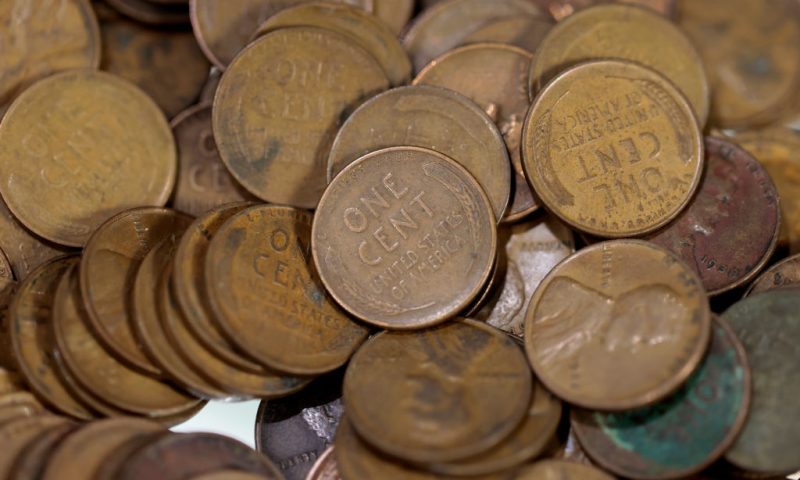
(NEXSTAR) — Amid a widespread penny shortage that has prompted businesses to offer snacks, drinks, and gift cards (as well as warnings about incorrect change) in exchange for Lincoln cents, you may find yourself looking at your stash of pennies with dollar signs in your eyes.
Spoiler alert: Your pennies may not be worth much more than the aforementioned freebies. That is, of course, dependent on a few engraved features: the year, wheat sheaves, and, if you’re lucky, three initials.
In recent years, there have been pennies that have sold at auction for hundreds or thousands of dollars. A rare few have been known to fetch more than $1 million.
In 2022, for example, 10 pennies from more than a century ago sold for a combined $1.1 million at auction. NewsNation affiliate KTLA reported at the time that the pennies were specifically made for collectors.
Produced between 1909 and 1915, the coins are considered wheat pennies, which are considered the most commonly collected U.S. coins today.
Between 1909 and 1958, pennies featured two sheaves of wheat on their reverse. During those nearly 50 years, small changes were made to the pennies. Early on, the initials of sculptor-engraver Victor David Brenner appeared on the reverse of the penny.

A penny bearing “V.D.B.” beneath its wheat sheaves was among those that sold in 2022; that coin alone went for $365,000. In January, a highly graded wheat penny from the same series sold for $99,000 at auction.
Another, minted in Denver in 1943, sold for $840,000 in 2021, according to a listing by Heritage Auctions. Pennies of that series were made of bronze rather than the zinc-coated steel the U.S. was using at the time, amidst the war efforts. Another wheat penny from 1944 — made entirely of steel, giving it a silver appearance instead of copper or bronze — sold at auction for $168,000 in January.
Dave Sorrick, coin expert and collector at In God We Trust, LLC, previously told NewsNation affiliate KSNF/KODE that a wheat penny from 1909 could be “worth anywhere from $700 to $1,500 depending on the coin’s grade.” An uncirculated wheat penny from 1909 that has been graded could be worth $2,000 to $3,000.
While online guides can give you insight into how valuable your wheat penny — or your dimes, or your state quarter collection, or your $1 bill, or your $2 bill — is or isn’t, it is generally recommended that you speak with an expert before listing your coin on eBay.
As for your wheatless, copper-plated zinc pennies that were produced in the last two decades, you may not find much of a collectors’ market for them.
Even when Canada ditched its penny and encouraged residents to turn theirs in, Canadians were only receiving face value for the coins: if you turned in 285 pennies, you received $2.85.
If you were hoping to leverage your pennies into a better deal, you may want to try a retailer that’s offering freebies in exchange for one-cent coins instead.